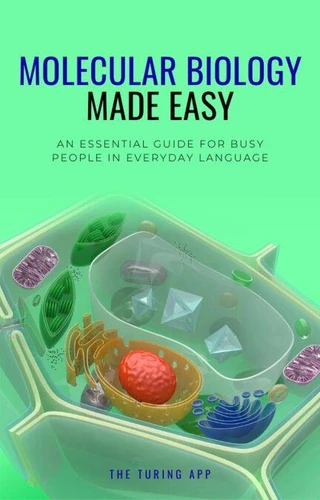
This book is an easy-to-follow journey into the hidden world inside every living thing: the cell. Written in everyday language for busy people, this is the simplest yet comprehensive introduction to Molecular Biology for EveryoneAt the center of molecular biology is the one big question: how does chemistry give rise to life? The book begins with the cell as life's basic unit: a self-maintaining, self-copying system with boundaries, instructions, energy, and internal order.
We explore the cell as a bustling city, with membranes as borders, organelles as specialized rooms, and trillions of human cells working together as a living society. From there, we move into life's raw ingredients: water, salts, sugars, fats, enzymes, and ATP, showing how weak forces, molecular shape, and energy flow make life possible. We then turn to proteins, the working machines of the cell, explaining how chains of amino acids fold into precise shapes that move muscles, carry cargo, send signals, fight disease, and become targets for modern drugs.
The book also opens the cell's instruction manual: DNA. It explains how the genome is packed, copied, repaired, regulated, and, increasingly, edited through tools like CRISPR. It follows the flow of information from gene to RNA to protein, showing how cells decide which instructions to use and how regulation gives a neuron, skin cell, or immune cell its identity. This is your gateway to genomic revolution driven by mutation, evolution, sequencing, pangenomes, single-cell technologies, and the emerging ability not just to read life's code, but to rewrite it.
This book is an easy-to-follow journey into the hidden world inside every living thing: the cell. Written in everyday language for busy people, this is the simplest yet comprehensive introduction to Molecular Biology for EveryoneAt the center of molecular biology is the one big question: how does chemistry give rise to life? The book begins with the cell as life's basic unit: a self-maintaining, self-copying system with boundaries, instructions, energy, and internal order.
We explore the cell as a bustling city, with membranes as borders, organelles as specialized rooms, and trillions of human cells working together as a living society. From there, we move into life's raw ingredients: water, salts, sugars, fats, enzymes, and ATP, showing how weak forces, molecular shape, and energy flow make life possible. We then turn to proteins, the working machines of the cell, explaining how chains of amino acids fold into precise shapes that move muscles, carry cargo, send signals, fight disease, and become targets for modern drugs.
The book also opens the cell's instruction manual: DNA. It explains how the genome is packed, copied, repaired, regulated, and, increasingly, edited through tools like CRISPR. It follows the flow of information from gene to RNA to protein, showing how cells decide which instructions to use and how regulation gives a neuron, skin cell, or immune cell its identity. This is your gateway to genomic revolution driven by mutation, evolution, sequencing, pangenomes, single-cell technologies, and the emerging ability not just to read life's code, but to rewrite it.

 , qui est-ce ?