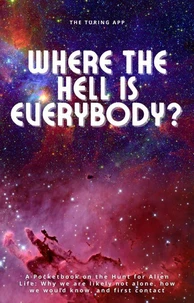
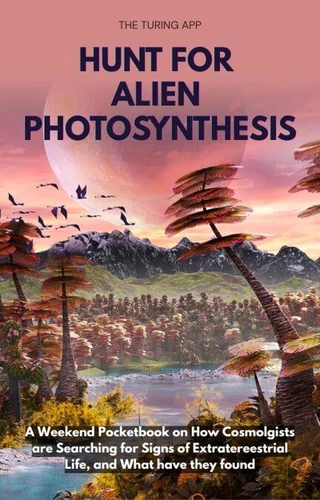
This book is a Weekend Pocketbook on Everything You Should Know About Finding Life on Exoplanets, the search for distant worlds that may carry the fingerprints of biology. Written in everyday language, we explore how astronomers detect planets we cannot truly see, why life can be so hard to prove, and how a few photons from another world could change humanity forever. How do you recognize a living planet from light-years away? We begin with the modern exoplanet revolution, where thousands of planets have already been confirmed, yet most remain little more than unresolved dots.
We explore why an Earth-like world is so difficult to study, how telescopes read starlight passing through alien atmospheres, and why gases such as oxygen, methane, phosphine, or dimethyl sulfide can mislead us when geology and sunlight imitate biology. Could a planet reveal oceans through glint, continents through changing brightness, or vegetation through a sharp "red edge" in reflected light? We discuss how rotating planets might be mapped from tiny variations in color, and why future telescopes may search not only for gases, but for the physical stage where life could exist.
We discuss polarization, ocean flashes, water-cloud rainbows, and the strange possibility that life itself may twist light through circular polarization. Could alien forests be black under red dwarf stars, purple like early Earth microbes, or something we have never imagined?The hunt is just beginning, and another pale dot may be waiting.
This book is a Weekend Pocketbook on Everything You Should Know About Finding Life on Exoplanets, the search for distant worlds that may carry the fingerprints of biology. Written in everyday language, we explore how astronomers detect planets we cannot truly see, why life can be so hard to prove, and how a few photons from another world could change humanity forever. How do you recognize a living planet from light-years away? We begin with the modern exoplanet revolution, where thousands of planets have already been confirmed, yet most remain little more than unresolved dots.
We explore why an Earth-like world is so difficult to study, how telescopes read starlight passing through alien atmospheres, and why gases such as oxygen, methane, phosphine, or dimethyl sulfide can mislead us when geology and sunlight imitate biology. Could a planet reveal oceans through glint, continents through changing brightness, or vegetation through a sharp "red edge" in reflected light? We discuss how rotating planets might be mapped from tiny variations in color, and why future telescopes may search not only for gases, but for the physical stage where life could exist.
We discuss polarization, ocean flashes, water-cloud rainbows, and the strange possibility that life itself may twist light through circular polarization. Could alien forests be black under red dwarf stars, purple like early Earth microbes, or something we have never imagined?The hunt is just beginning, and another pale dot may be waiting.

 , qui est-ce ?