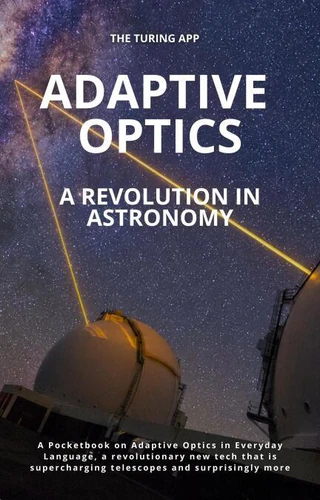
This book is a Weekend Pocketbook on Everything You Should Know About Adaptive Optics, the tech revolutionizing how scientists tame distorted light and sharpen our view of the universe, the sky around Earth, and even the living human body. On mountaintop observatories, light from distant galaxies travels across space for billions of years, only to be blurred in its final milliseconds by Earth's turbulent atmosphere.
Adaptive Optics uses seeing, diffraction limits, wavefront sensors, deformable mirrors, and the strange trick of creating artificial stars with lasers to let telescopes correct the sky in real time. How can a mirror that constantly bends itself make an image sharper? How can a telescope remove atmospheric shimmer a thousand times per second? Could corrected light help build quantum communication links between Earth and satellites? Could pre-shaped laser beams carry fragile quantum keys through the atmosphere without losing their secrets?Adaptive optics is helping astronomers glimpse worlds around other stars.
How do we see a planet hidden beside the glare of its sun? We discuss extreme adaptive optics, coronagraphs, baby planets, moon-forming disks, and the coming age of giant telescopes such as the Extremely Large Telescope (ELT) and the Giant Magellan Telescope (GMT). Could the same technology that untwinkles stars also transform medicine? Once we learn to correct the path of light, how many hidden worlds come into focus?
This book is a Weekend Pocketbook on Everything You Should Know About Adaptive Optics, the tech revolutionizing how scientists tame distorted light and sharpen our view of the universe, the sky around Earth, and even the living human body. On mountaintop observatories, light from distant galaxies travels across space for billions of years, only to be blurred in its final milliseconds by Earth's turbulent atmosphere.
Adaptive Optics uses seeing, diffraction limits, wavefront sensors, deformable mirrors, and the strange trick of creating artificial stars with lasers to let telescopes correct the sky in real time. How can a mirror that constantly bends itself make an image sharper? How can a telescope remove atmospheric shimmer a thousand times per second? Could corrected light help build quantum communication links between Earth and satellites? Could pre-shaped laser beams carry fragile quantum keys through the atmosphere without losing their secrets?Adaptive optics is helping astronomers glimpse worlds around other stars.
How do we see a planet hidden beside the glare of its sun? We discuss extreme adaptive optics, coronagraphs, baby planets, moon-forming disks, and the coming age of giant telescopes such as the Extremely Large Telescope (ELT) and the Giant Magellan Telescope (GMT). Could the same technology that untwinkles stars also transform medicine? Once we learn to correct the path of light, how many hidden worlds come into focus?

 , qui est-ce ?