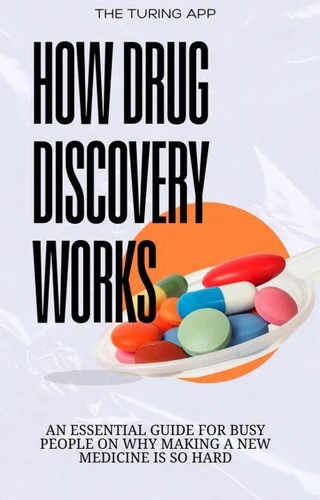
This book is a Weekend Pocketbook on Everything You Should Know About How New Medicines Are Made, the long, expensive, and uncertain journey from a promising idea to a drug in your hand. Written in everyday language, we explore why every pill in a medicine cabinet is a survivor of a brutal scientific obstacle course. Why is making a new medicine so hard? We begin with the scale of the challenge: scientists may start with thousands of possible compounds, only to watch nearly all of them fail because they do not work, prove toxic, or cannot be manufactured reliably.
We explore why the human body is not a simple machine, but a storm of proteins, signals, cells, organs, and feedback loops where one helpful molecule can also cause unexpected harm. We then follow the search for a starting point. How do scientists find the first molecule worth pursuing? We discuss old-fashioned serendipity, high-throughput screening, rational drug design, artificial intelligence (AI), natural products, existing drug libraries, and deoxyribonucleic acid (DNA)-encoded libraries.
Along the way, we ask how researchers design a chemical "key" for a biological "lock, " and why even a brilliant early hit is still only the beginning. The book also explores the rise of new kinds of medicine. We move beyond traditional small molecules into biologics, monoclonal antibodies, antibody-drug conjugates, chimeric antigen receptor T cell (CAR T cell) therapy, messenger ribonucleic acid (mRNA) vaccines, gene therapy, clustered regularly interspaced short palindromic repeats (CRISPR), and ribonucleic acid (RNA) interference.
This book is a Weekend Pocketbook on Everything You Should Know About How New Medicines Are Made, the long, expensive, and uncertain journey from a promising idea to a drug in your hand. Written in everyday language, we explore why every pill in a medicine cabinet is a survivor of a brutal scientific obstacle course. Why is making a new medicine so hard? We begin with the scale of the challenge: scientists may start with thousands of possible compounds, only to watch nearly all of them fail because they do not work, prove toxic, or cannot be manufactured reliably.
We explore why the human body is not a simple machine, but a storm of proteins, signals, cells, organs, and feedback loops where one helpful molecule can also cause unexpected harm. We then follow the search for a starting point. How do scientists find the first molecule worth pursuing? We discuss old-fashioned serendipity, high-throughput screening, rational drug design, artificial intelligence (AI), natural products, existing drug libraries, and deoxyribonucleic acid (DNA)-encoded libraries.
Along the way, we ask how researchers design a chemical "key" for a biological "lock, " and why even a brilliant early hit is still only the beginning. The book also explores the rise of new kinds of medicine. We move beyond traditional small molecules into biologics, monoclonal antibodies, antibody-drug conjugates, chimeric antigen receptor T cell (CAR T cell) therapy, messenger ribonucleic acid (mRNA) vaccines, gene therapy, clustered regularly interspaced short palindromic repeats (CRISPR), and ribonucleic acid (RNA) interference.

 , qui est-ce ?