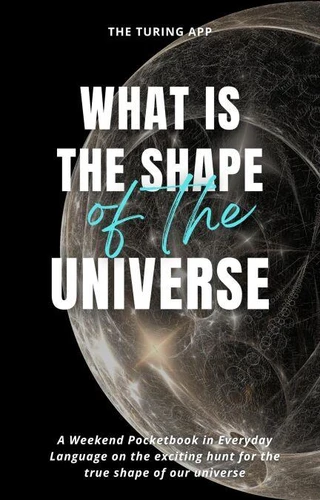
This book is a Weekend Pocketbook on Everything You Should Know About the Shape of the Universe, the story of one of cosmology's oldest and biggest questions: what does the whole cosmos look like? Written in everyday language, we explore whether space is infinite, curved, flat, folded, wrapped, or hiding a shape too large for us to see. What if the universe only looks endless because we are too small to notice the curve?We begin with the difference between geometry and topology.
Geometry asks whether space is flat like a sheet, curved like a sphere, or shaped more like a saddle. Topology asks a deeper question: how is the whole universe stitched together? Could space be locally flat but globally finite, like a hall of mirrors where light might one day return from behind us?We then turn to the Cosmic Microwave Background (CMB), the oldest light in the universe. Tiny hot and cold spots in this ancient glow act like clues from the infant cosmos.
Why do their sizes tell us about the shape of space? And if the universe appears almost perfectly flat, does that really prove it goes on forever?If space wraps around itself, should we see matching circles in the CMB, repeated galaxies, or echoes of the same cosmic structures? If we can not see, could we listen for the shape of the cosmos? Is the edge of the universe real, or only the edge of what we are able to see?
This book is a Weekend Pocketbook on Everything You Should Know About the Shape of the Universe, the story of one of cosmology's oldest and biggest questions: what does the whole cosmos look like? Written in everyday language, we explore whether space is infinite, curved, flat, folded, wrapped, or hiding a shape too large for us to see. What if the universe only looks endless because we are too small to notice the curve?We begin with the difference between geometry and topology.
Geometry asks whether space is flat like a sheet, curved like a sphere, or shaped more like a saddle. Topology asks a deeper question: how is the whole universe stitched together? Could space be locally flat but globally finite, like a hall of mirrors where light might one day return from behind us?We then turn to the Cosmic Microwave Background (CMB), the oldest light in the universe. Tiny hot and cold spots in this ancient glow act like clues from the infant cosmos.
Why do their sizes tell us about the shape of space? And if the universe appears almost perfectly flat, does that really prove it goes on forever?If space wraps around itself, should we see matching circles in the CMB, repeated galaxies, or echoes of the same cosmic structures? If we can not see, could we listen for the shape of the cosmos? Is the edge of the universe real, or only the edge of what we are able to see?

 , qui est-ce ?