This book is a Weekend Pocketbook on Everything You Should Know About the Mathematics of Climate Models. Have you wondered how much of climate science is based on robust data vs what is Guesswork? Written in everyday language, we explore what climate models can tell us with confidence, where uncertainty enters, and what is speculation? How well can mathematics predict the future of a planet?We begin with the foundations of climate modeling: What science are we sure of? We venture into understanding the effects of carbon dioxide (CO2), energy balance, thermodynamics, radiation, ocean heat, and the Navier-Stokes equations, which describe the motion of air and water.
Why does a gas in the atmosphere change the planet's temperature? Why do models built from old physical laws still sit at the heart of modern climate science?We then enter the strange world of chaos: Science we think we know but can't be sure of. A tiny rounding error in Edward Lorenz's weather model helped reveal the butterfly effect, but what does that really mean for climate prediction? If weather is unpredictable after a few weeks, how can scientists still speak about climate decades from now? We explore ensemble forecasting, uncertainty ranges, and the difference between a single storm and the long-term statistics of a warming world.
From there, we move into the gray zones: clouds, aerosols, regional rainfall, downscaling, parameterization, and machine learning. What happens inside the "pixels" of a climate model, where clouds form, particles scatter light, and local details are too small for global simulations to see directly?Finally, we reach the frontier: tipping points, ice sheets, ocean currents, methane feedbacks, extreme events, fat-tailed risks, and Extreme Value Theory (EVT).
Could parts of Earth's climate cross hidden thresholds before we recognize them? This pocketbook ends with a question at the heart of the climate debate: when the future is uncertain, how much certainty do we need before we act?
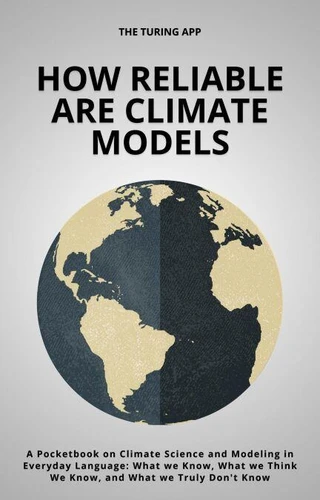
This book is a Weekend Pocketbook on Everything You Should Know About the Mathematics of Climate Models. Have you wondered how much of climate science is based on robust data vs what is Guesswork? Written in everyday language, we explore what climate models can tell us with confidence, where uncertainty enters, and what is speculation? How well can mathematics predict the future of a planet?We begin with the foundations of climate modeling: What science are we sure of? We venture into understanding the effects of carbon dioxide (CO2), energy balance, thermodynamics, radiation, ocean heat, and the Navier-Stokes equations, which describe the motion of air and water.
Why does a gas in the atmosphere change the planet's temperature? Why do models built from old physical laws still sit at the heart of modern climate science?We then enter the strange world of chaos: Science we think we know but can't be sure of. A tiny rounding error in Edward Lorenz's weather model helped reveal the butterfly effect, but what does that really mean for climate prediction? If weather is unpredictable after a few weeks, how can scientists still speak about climate decades from now? We explore ensemble forecasting, uncertainty ranges, and the difference between a single storm and the long-term statistics of a warming world.
From there, we move into the gray zones: clouds, aerosols, regional rainfall, downscaling, parameterization, and machine learning. What happens inside the "pixels" of a climate model, where clouds form, particles scatter light, and local details are too small for global simulations to see directly?Finally, we reach the frontier: tipping points, ice sheets, ocean currents, methane feedbacks, extreme events, fat-tailed risks, and Extreme Value Theory (EVT).
Could parts of Earth's climate cross hidden thresholds before we recognize them? This pocketbook ends with a question at the heart of the climate debate: when the future is uncertain, how much certainty do we need before we act?

 , qui est-ce ?