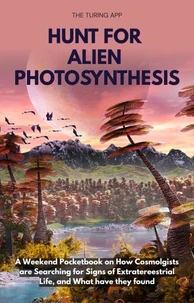
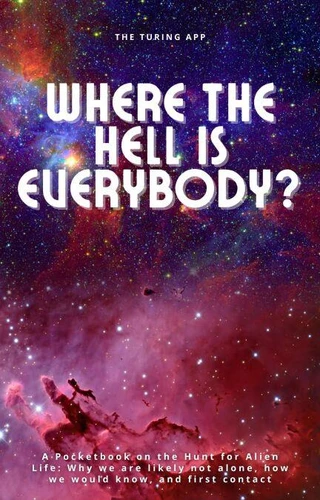
This book is a Weekend Pocketbook on Everything You Should Know About the Search for Alien Life, the hunt for biosignatures, technosignatures, and attempts to contact intelligent life out thereIf the universe is so vast, why has nobody said hello?We begin with the Fermi Paradox: the uncomfortable gap between how many worlds should exist and how silent the sky still feels. Are civilizations rare? Do they vanish quickly? Are we looking in the wrong way, or asking the wrong question?If alien plants exist, would they rely on photosynthesis like Earth's plants do? Could another world have forests that are not green, oceans with strange pigments, or atmospheres marked by life quietly changing the light of a planet?If we can not find signs of photosynthesis, can we instead look for technosignatures: clues that may not come from biology, but from intelligence? Could a distant civilization leave fingerprints in waste heat, artificial lights, unusual chemicals, radio pulses, or structures too strange for nature to build?We end with humanity's boldest gestures: an attempt to contact alien life via the Arecibo Message.
In 1974, we sent a tiny postcard into the dark, packed with numbers, chemistry, DNA, and a sketch of ourselves. Was it a greeting, a gamble, or just a mirror held up to our own loneliness?You may not realize this, but now is the best time for aliens to find us. Find out why?
This book is a Weekend Pocketbook on Everything You Should Know About the Search for Alien Life, the hunt for biosignatures, technosignatures, and attempts to contact intelligent life out thereIf the universe is so vast, why has nobody said hello?We begin with the Fermi Paradox: the uncomfortable gap between how many worlds should exist and how silent the sky still feels. Are civilizations rare? Do they vanish quickly? Are we looking in the wrong way, or asking the wrong question?If alien plants exist, would they rely on photosynthesis like Earth's plants do? Could another world have forests that are not green, oceans with strange pigments, or atmospheres marked by life quietly changing the light of a planet?If we can not find signs of photosynthesis, can we instead look for technosignatures: clues that may not come from biology, but from intelligence? Could a distant civilization leave fingerprints in waste heat, artificial lights, unusual chemicals, radio pulses, or structures too strange for nature to build?We end with humanity's boldest gestures: an attempt to contact alien life via the Arecibo Message.
In 1974, we sent a tiny postcard into the dark, packed with numbers, chemistry, DNA, and a sketch of ourselves. Was it a greeting, a gamble, or just a mirror held up to our own loneliness?You may not realize this, but now is the best time for aliens to find us. Find out why?

 , qui est-ce ?