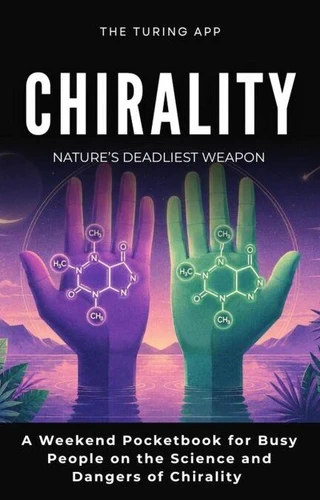
This book is a Weekend Pocketbook on Everything You Should Know About Chirality and Mirror Life, the hidden handedness of biology and the unsettling possibility of building life in reverse. Written in everyday language, we explore why molecules can have left- and right-handed forms, why life on Earth chose only one molecular orientation, and what could happen if science learns to flip that choice.
What if life's operating system has a mirror version? Chirality refers to the fact that some molecules come in two mirror-image forms that cannot be perfectly aligned. Your proteins are built from left-handed amino acids, while deoxyribonucleic acid (DNA) and ribonucleic acid (RNA) use right-handed sugars. This asymmetry shapes everything from taste and smell to medicine, metabolism, infection, and survival.
We explore how scientists discovered this hidden twist, from Louis Pasteur's hand-sorted crystals to the tragic lesson of thalidomide, where two mirror forms of the same drug had radically different biological effects. We also look at newer research suggesting that minerals, magnetism, meteorites, and even interstellar chemistry may have helped push life toward one molecular hand in the first place.
There is a darker side to Chirality: what happens if we create mirror life? We discuss mirror peptides, mirror DNA, synthetic cells, chiral drugs, data storage, industrial chemistry, and the powerful benefits that controlled chirality could bring. A self-replicating mirror organism might evade immune systems, antibiotics, viruses, fungi, and ecological checks because ordinary biology may not recognize it.
The mirror is full of promise, but once life's handedness is reversed, can we still control what looks back.
This book is a Weekend Pocketbook on Everything You Should Know About Chirality and Mirror Life, the hidden handedness of biology and the unsettling possibility of building life in reverse. Written in everyday language, we explore why molecules can have left- and right-handed forms, why life on Earth chose only one molecular orientation, and what could happen if science learns to flip that choice.
What if life's operating system has a mirror version? Chirality refers to the fact that some molecules come in two mirror-image forms that cannot be perfectly aligned. Your proteins are built from left-handed amino acids, while deoxyribonucleic acid (DNA) and ribonucleic acid (RNA) use right-handed sugars. This asymmetry shapes everything from taste and smell to medicine, metabolism, infection, and survival.
We explore how scientists discovered this hidden twist, from Louis Pasteur's hand-sorted crystals to the tragic lesson of thalidomide, where two mirror forms of the same drug had radically different biological effects. We also look at newer research suggesting that minerals, magnetism, meteorites, and even interstellar chemistry may have helped push life toward one molecular hand in the first place.
There is a darker side to Chirality: what happens if we create mirror life? We discuss mirror peptides, mirror DNA, synthetic cells, chiral drugs, data storage, industrial chemistry, and the powerful benefits that controlled chirality could bring. A self-replicating mirror organism might evade immune systems, antibiotics, viruses, fungi, and ecological checks because ordinary biology may not recognize it.
The mirror is full of promise, but once life's handedness is reversed, can we still control what looks back.

 , qui est-ce ?