SOLDES
Jusqu'à -70% sur une sélection d'articles*

Nouveauté
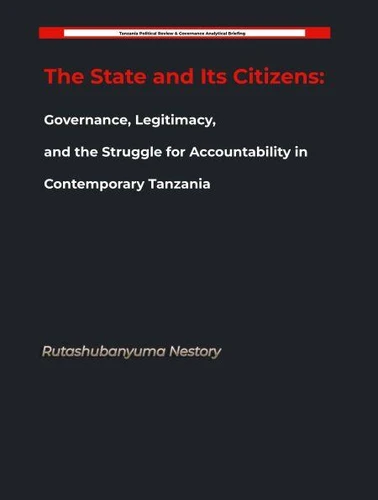
The State and Its Citizens: Governance, Legitimacy, and the Struggle for Accountability in Contemporary Tanzania
Par :Formats :
Disponible dans votre compte client Decitre ou Furet du Nord dès validation de votre commande. Le format ePub est :
- Compatible avec une lecture sur My Vivlio (smartphone, tablette, ordinateur)
- Compatible avec une lecture sur liseuses Vivlio
- Pour les liseuses autres que Vivlio, vous devez utiliser le logiciel Adobe Digital Edition. Non compatible avec la lecture sur les liseuses Kindle, Remarkable et Sony
 , qui est-ce ?
Notre partenaire de plateforme de lecture numérique où vous retrouverez l'ensemble de vos ebooks gratuitement
Pour en savoir plus sur nos ebooks, consultez notre aide en ligne ici
C'est si simple ! Lisez votre ebook avec l'app Vivlio sur votre tablette, mobile ou ordinateur :

- FormatePub
- ISBN8235821095
- EAN9798235821095
- Date de parution17/06/2026
- Protection num.pas de protection
- Infos supplémentairesepub
- ÉditeurIoakim Ioakim
Résumé
What happens when official promises collide with lived realities?Contemporary Tanzania stands at a defining crossroads, navigating profound political, economic, and social transformations. The State and Its Citizens examines this moment through the interconnected lenses of governance, law, political competition, and institutional credibility. From contested urban redevelopment and struggles over land rights to digital battlegrounds of information and influence; from religious leaders calling for accountability to opposition movements testing the boundaries of political space, this volume explores how citizens encounter the state-and how public trust is built, weakened, and rebuilt.
Across twenty chapters, the collection examines questions of authority, legitimacy, and accountability through issues including resource governance, Union tensions, celebrity politics, civic activism, and institutional power. It argues that institutions derive their legitimacy not merely from their formal existence, but from the everyday experiences of the people they are meant to serve. Courts, security agencies, political parties, and public authorities gain credibility when citizens perceive them as fair, transparent, and accountable.
Throughout the volume, critical questions emerge: Why are constitutional protections and public commitments so often separated from reality? When does the pursuit of stability become a justification for restricting civic freedoms? And how can institutions entrusted with power balance authority with justice?The State and Its Citizens offers no simplistic conclusions. Instead, it provides a sustained examination of the foundations of legitimate governance and the evolving relationship between state and society.
It is essential reading for those concerned with Tanzania's democratic future-and for anyone who believes that strong institutions must serve citizens, not merely those who exercise power.
Across twenty chapters, the collection examines questions of authority, legitimacy, and accountability through issues including resource governance, Union tensions, celebrity politics, civic activism, and institutional power. It argues that institutions derive their legitimacy not merely from their formal existence, but from the everyday experiences of the people they are meant to serve. Courts, security agencies, political parties, and public authorities gain credibility when citizens perceive them as fair, transparent, and accountable.
Throughout the volume, critical questions emerge: Why are constitutional protections and public commitments so often separated from reality? When does the pursuit of stability become a justification for restricting civic freedoms? And how can institutions entrusted with power balance authority with justice?The State and Its Citizens offers no simplistic conclusions. Instead, it provides a sustained examination of the foundations of legitimate governance and the evolving relationship between state and society.
It is essential reading for those concerned with Tanzania's democratic future-and for anyone who believes that strong institutions must serve citizens, not merely those who exercise power.