SOLDES
Jusqu'à -70% sur une sélection d'articles*

Nouveauté
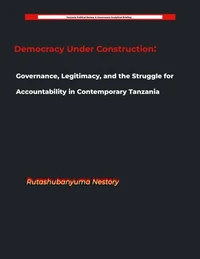
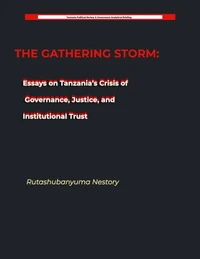
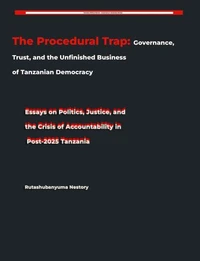
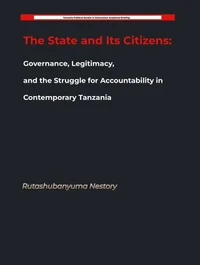
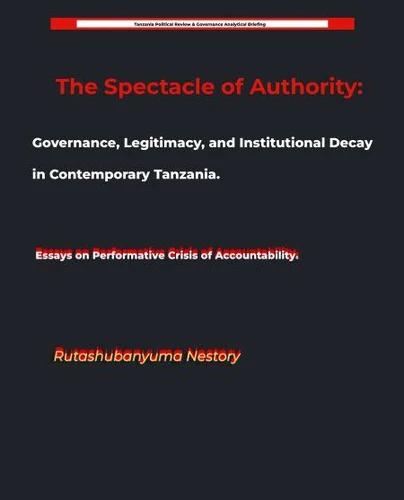
The Spectacle of Authority: Governance, Legitimacy, and Institutional Decay in Contemporary Tanzania Essays on Performative Crisis of Accountability
Par :Formats :
Disponible dans votre compte client Decitre ou Furet du Nord dès validation de votre commande. Le format ePub est :
- Compatible avec une lecture sur My Vivlio (smartphone, tablette, ordinateur)
- Compatible avec une lecture sur liseuses Vivlio
- Pour les liseuses autres que Vivlio, vous devez utiliser le logiciel Adobe Digital Edition. Non compatible avec la lecture sur les liseuses Kindle, Remarkable et Sony
 , qui est-ce ?
Notre partenaire de plateforme de lecture numérique où vous retrouverez l'ensemble de vos ebooks gratuitement
Pour en savoir plus sur nos ebooks, consultez notre aide en ligne ici
C'est si simple ! Lisez votre ebook avec l'app Vivlio sur votre tablette, mobile ou ordinateur :

- FormatePub
- ISBN8235582446
- EAN9798235582446
- Date de parution06/06/2026
- Protection num.pas de protection
- Infos supplémentairesepub
- ÉditeurIoakim Ioakim
Résumé
This volume analyzes the relationship between political authority and institutional performance in contemporary Tanzania. Across thirty-two chapters, it identifies a recurring governance pattern: the substitution of episodic, high-visibility executive intervention for routine, rule-based institutional functioning. The central analytical concept is performative legitimacy, defined as a mode of governance in which political authority derives credibility from visible acts of intervention rather than from the consistent operation of institutions.
In this configuration, leaders resolve selected cases in public settings, generating an impression of responsiveness while underlying administrative and judicial weaknesses persist. Empirically, the chapters span energy governance, foreign policy, parliamentary politics, legal enforcement, infrastructure systems, conservation policy, donor relations, and social welfare administration. Despite this diversity, a consistent pattern is evident: formal institutions frequently fail to implement their own decisions, and executive authority subsequently intervenes to resolve isolated cases.
The volume argues that this dynamic produces several structural consequences. It weakens rights-based citizenship by reframing entitlements as discretionary favors. It incentivizes political escalation over legal recourse. It normalizes institutional underperformance as long as failures remain politically invisible. And it consolidates a form of governance in which accountability is mediated through visibility rather than law.
Rather than offering policy prescriptions, the volume provides a conceptual framework for interpreting systemic governance behavior across fragmented but interconnected domains.
In this configuration, leaders resolve selected cases in public settings, generating an impression of responsiveness while underlying administrative and judicial weaknesses persist. Empirically, the chapters span energy governance, foreign policy, parliamentary politics, legal enforcement, infrastructure systems, conservation policy, donor relations, and social welfare administration. Despite this diversity, a consistent pattern is evident: formal institutions frequently fail to implement their own decisions, and executive authority subsequently intervenes to resolve isolated cases.
The volume argues that this dynamic produces several structural consequences. It weakens rights-based citizenship by reframing entitlements as discretionary favors. It incentivizes political escalation over legal recourse. It normalizes institutional underperformance as long as failures remain politically invisible. And it consolidates a form of governance in which accountability is mediated through visibility rather than law.
Rather than offering policy prescriptions, the volume provides a conceptual framework for interpreting systemic governance behavior across fragmented but interconnected domains.