SOLDES
Jusqu'à -70% sur une sélection d'articles*

Nouveauté
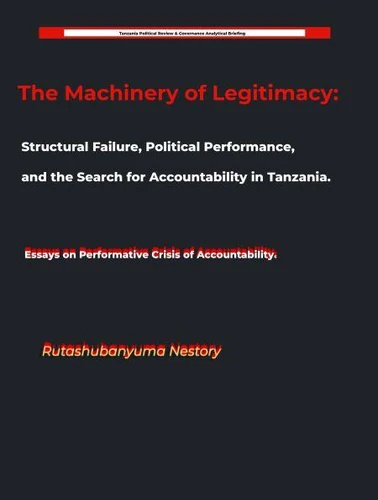
The Machinery of Legitimacy Structural Failure, Political Performance, and the Search for Accountability in Tanzania
Par :Formats :
Disponible dans votre compte client Decitre ou Furet du Nord dès validation de votre commande. Le format ePub est :
- Compatible avec une lecture sur My Vivlio (smartphone, tablette, ordinateur)
- Compatible avec une lecture sur liseuses Vivlio
- Pour les liseuses autres que Vivlio, vous devez utiliser le logiciel Adobe Digital Edition. Non compatible avec la lecture sur les liseuses Kindle, Remarkable et Sony
 , qui est-ce ?
Notre partenaire de plateforme de lecture numérique où vous retrouverez l'ensemble de vos ebooks gratuitement
Pour en savoir plus sur nos ebooks, consultez notre aide en ligne ici
C'est si simple ! Lisez votre ebook avec l'app Vivlio sur votre tablette, mobile ou ordinateur :

- FormatePub
- ISBN8235194922
- EAN9798235194922
- Date de parution07/06/2026
- Protection num.pas de protection
- Infos supplémentairesepub
- ÉditeurIoakim Ioakim
Résumé
Why do reforms so often fail to deliver the results they promise? Why do institutions that appear strong on paper struggle to produce accountability, legitimacy, and public trust? And why does political performance so frequently substitute for substantive change?In The Machinery of Legitimacy: Structural Failure, Political Performance, and the Search for Accountability in Tanzania, the author examines these questions through thirty interconnected essays exploring governance, law, politics, diplomacy, and public policy in contemporary Tanzania.
From poverty reduction strategies and electoral contestation to parliamentary authority, opposition politics, international diplomacy, regulatory enforcement, digital rights, and international criminal justice, the book reveals how institutional structures often reward symbolism over substance, procedure over outcomes, and rhetoric over accountability. Combining political economy, legal analysis, and governance studies, this volume challenges both official narratives and opposition assumptions.
It argues that many of Tanzania's persistent governance challenges are not merely the result of individual failures, but are rooted in deeper institutional arrangements that shape incentives, constrain reform, and influence public perceptions of legitimacy. Provocative, evidence-based, and accessible, this book offers a critical framework for understanding the evolving relationship between power, accountability, and governance in one of Africa's most important states.
Essential reading for scholars, policymakers, journalists, civil society practitioners, students, and all those interested in the future of governance and democratic accountability in Tanzania and East Africa.
From poverty reduction strategies and electoral contestation to parliamentary authority, opposition politics, international diplomacy, regulatory enforcement, digital rights, and international criminal justice, the book reveals how institutional structures often reward symbolism over substance, procedure over outcomes, and rhetoric over accountability. Combining political economy, legal analysis, and governance studies, this volume challenges both official narratives and opposition assumptions.
It argues that many of Tanzania's persistent governance challenges are not merely the result of individual failures, but are rooted in deeper institutional arrangements that shape incentives, constrain reform, and influence public perceptions of legitimacy. Provocative, evidence-based, and accessible, this book offers a critical framework for understanding the evolving relationship between power, accountability, and governance in one of Africa's most important states.
Essential reading for scholars, policymakers, journalists, civil society practitioners, students, and all those interested in the future of governance and democratic accountability in Tanzania and East Africa.