SOLDES
Jusqu'à -70% sur une sélection d'articles*

Nouveauté
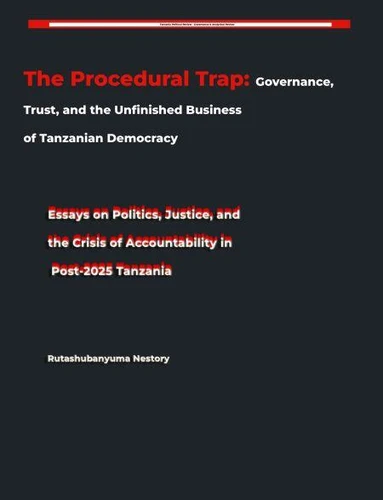
The Procedural Trap: Governance, Trust, and the Unfinished Business of Tanzanian Democracy Essays on Politics, Justice, and the Crisis of Accountability in Post-2025 Tanzania
Par :Formats :
Disponible dans votre compte client Decitre ou Furet du Nord dès validation de votre commande. Le format ePub est :
- Compatible avec une lecture sur My Vivlio (smartphone, tablette, ordinateur)
- Compatible avec une lecture sur liseuses Vivlio
- Pour les liseuses autres que Vivlio, vous devez utiliser le logiciel Adobe Digital Edition. Non compatible avec la lecture sur les liseuses Kindle, Remarkable et Sony
 , qui est-ce ?
Notre partenaire de plateforme de lecture numérique où vous retrouverez l'ensemble de vos ebooks gratuitement
Pour en savoir plus sur nos ebooks, consultez notre aide en ligne ici
C'est si simple ! Lisez votre ebook avec l'app Vivlio sur votre tablette, mobile ou ordinateur :

- FormatePub
- ISBN8235072787
- EAN9798235072787
- Date de parution19/06/2026
- Protection num.pas de protection
- Infos supplémentairesepub
- ÉditeurIoakim Ioakim
Résumé
What happens when democratic procedures become substitutes for democratic substance?In the aftermath of Tanzania's contested 2025 elections, a pattern has emerged across the country's political and institutional landscape: formal processes increasingly function as barriers to accountability rather than pathways to justice. The Procedural Trap offers a critical examination of this phenomenon through thirty-one essays spanning constitutional reform, political succession, economic governance, electoral justice, policing, and administrative accountability.
From the funeral in Siha where mourners placed a coffin on the District Commissioner's vehicle to demand the release of arrested colleagues, to the prolonged failure to compensate Kagera war veterans more than four decades after their service, to shifting official narratives surrounding Tanzania's gold reserves-these essays illuminate a governance environment where procedure often displaces justice, and institutional continuity is frequently prioritised over democratic transformation.
The collection examines rising tensions within Tanzania's ruling party as succession politics intensify ahead of the 2030 transition, the strategic calculations of opposition parties engaging with Zanzibar's Government of National Unity framework, and a constitutional reform debate that risks repeating the limitations of the 2014 process, where broad consultation produced limited structural change.
Drawing on parliamentary records, court rulings, policy statements, and public reporting, the author shows how actors across the political spectrum employ proceduralism both as a tool of governance and as a mechanism of containment. Meetings, timelines, legal thresholds, and evidentiary rules frequently become the very instruments through which substantive accountability is delayed or denied. The Procedural Trap is essential reading for scholars of Tanzanian politics, legal practitioners, civil society actors, journalists, and citizens concerned with the future of democratic governance.
It offers neither partisan polemic nor easy prescriptions, but instead a sustained analytical account of how institutional form can drift away from democratic purpose-and what is at stake when it does. Ultimately, the book argues that democratic institutions must be evaluated not by the elegance of their procedures, but by whether those procedures produce justice, accountability, and meaningful public participation.
From the funeral in Siha where mourners placed a coffin on the District Commissioner's vehicle to demand the release of arrested colleagues, to the prolonged failure to compensate Kagera war veterans more than four decades after their service, to shifting official narratives surrounding Tanzania's gold reserves-these essays illuminate a governance environment where procedure often displaces justice, and institutional continuity is frequently prioritised over democratic transformation.
The collection examines rising tensions within Tanzania's ruling party as succession politics intensify ahead of the 2030 transition, the strategic calculations of opposition parties engaging with Zanzibar's Government of National Unity framework, and a constitutional reform debate that risks repeating the limitations of the 2014 process, where broad consultation produced limited structural change.
Drawing on parliamentary records, court rulings, policy statements, and public reporting, the author shows how actors across the political spectrum employ proceduralism both as a tool of governance and as a mechanism of containment. Meetings, timelines, legal thresholds, and evidentiary rules frequently become the very instruments through which substantive accountability is delayed or denied. The Procedural Trap is essential reading for scholars of Tanzanian politics, legal practitioners, civil society actors, journalists, and citizens concerned with the future of democratic governance.
It offers neither partisan polemic nor easy prescriptions, but instead a sustained analytical account of how institutional form can drift away from democratic purpose-and what is at stake when it does. Ultimately, the book argues that democratic institutions must be evaluated not by the elegance of their procedures, but by whether those procedures produce justice, accountability, and meaningful public participation.