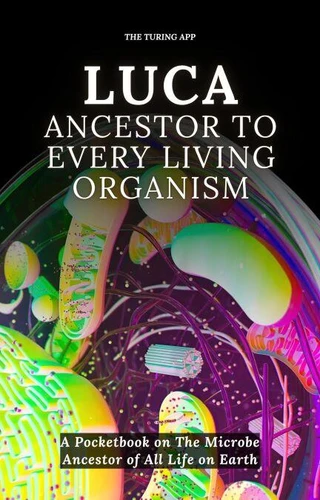
This book is a Weekend Pocketbook on Everything You Should Know About the Last Universal Common Ancestor (LUCA), the ancient root from which every living thing on Earth descends. Written in everyday language, we explore how life may have emerged on a young, violent planet, and why the deepest story of biology is also the story of us. How far back can we trace the family tree of life? We begin on early Earth, more than 4 billion years ago, when oceans, volcanic chemistry, asteroid impacts, and mineral-rich environments may have set the stage for life's first experiments.
We explore how scientists moved from Darwin's idea of a "primordial form" to Carl Woese's revolutionary use of ribosomal RNA (rRNA), which revealed the three domains of life: Bacteria, Archaea, and Eukarya. We then ask what LUCA really was. Was it a single organism, or part of a tangled community of early cells swapping genes through horizontal gene transfer? Was it born in hydrothermal vents, warm surface pools, or some other chemical nursery we have not yet imagined? And if LUCA already had a surprisingly complex genetic toolkit, does that mean life began even earlier than we thought?Recent research suggests LUCA may have carried thousands of genes, used hydrogen and carbon dioxide for energy, and may even have had an early Clustered Regularly Interspaced Short Palindromic Repeats (CRISPR)-like defense against ancient viruses.
If life became complex so quickly here, could similar beginnings unfold beneath the icy shells of Europa or Enceladus? Every cell alive today still carries echoes of LUCA's ancient language.
This book is a Weekend Pocketbook on Everything You Should Know About the Last Universal Common Ancestor (LUCA), the ancient root from which every living thing on Earth descends. Written in everyday language, we explore how life may have emerged on a young, violent planet, and why the deepest story of biology is also the story of us. How far back can we trace the family tree of life? We begin on early Earth, more than 4 billion years ago, when oceans, volcanic chemistry, asteroid impacts, and mineral-rich environments may have set the stage for life's first experiments.
We explore how scientists moved from Darwin's idea of a "primordial form" to Carl Woese's revolutionary use of ribosomal RNA (rRNA), which revealed the three domains of life: Bacteria, Archaea, and Eukarya. We then ask what LUCA really was. Was it a single organism, or part of a tangled community of early cells swapping genes through horizontal gene transfer? Was it born in hydrothermal vents, warm surface pools, or some other chemical nursery we have not yet imagined? And if LUCA already had a surprisingly complex genetic toolkit, does that mean life began even earlier than we thought?Recent research suggests LUCA may have carried thousands of genes, used hydrogen and carbon dioxide for energy, and may even have had an early Clustered Regularly Interspaced Short Palindromic Repeats (CRISPR)-like defense against ancient viruses.
If life became complex so quickly here, could similar beginnings unfold beneath the icy shells of Europa or Enceladus? Every cell alive today still carries echoes of LUCA's ancient language.

 , qui est-ce ?