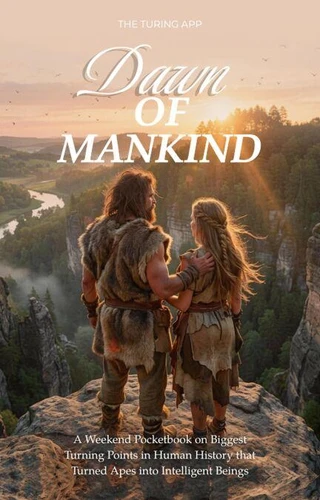
This book is a Weekend Pocketbook on Everything You Should Know About the Dawn of Mankind, the story of how fragile primates became toolmakers, storytellers, farmers, and builders of civilization. We explore the great leaps that turned human beings from prey into creators of the modern world. How did a species with no claws, no armor, and no great physical strength come to reshape the planet? We begin with the first tools, when early humans learned to turn stone, bone, and wood into extensions of the hand and mind.
We explore how Homo habilis and Homo erectus used simple flakes, choppers, and hand axes not merely to survive, but to begin a technological tradition that would one day lead to cities, machines, and spaceflight. We then follow the mastery of fire, one of the most important turning points in human history. Fire gave our ancestors warmth, protection, cooked food, longer evenings, and perhaps the first true gathering place.
Around its glow, knowledge could be shared, gestures could become meaningful, and early culture may have begun to take shape. From there, we explore the birth of language and symbols. How did sounds become words? How did words become memory, myth, identity, and shared belief? We discuss speech, the FOXP2 gene, early symbolic artifacts, cave paintings, rituals, and the power of stories to hold larger groups together.
Finally, we discuss agriculture, the revolution that changed everything. Instead of chasing food, humans learned to grow it, store it, defend it, and build around it. We explore the first farmers, domesticated plants and animals, early villages such as Jericho and Çatalhöyük, trade, property, governance, temples, conflict, and the birth of writing. The world would look very different if any one of these revolutions had never happened.
This book is a Weekend Pocketbook on Everything You Should Know About the Dawn of Mankind, the story of how fragile primates became toolmakers, storytellers, farmers, and builders of civilization. We explore the great leaps that turned human beings from prey into creators of the modern world. How did a species with no claws, no armor, and no great physical strength come to reshape the planet? We begin with the first tools, when early humans learned to turn stone, bone, and wood into extensions of the hand and mind.
We explore how Homo habilis and Homo erectus used simple flakes, choppers, and hand axes not merely to survive, but to begin a technological tradition that would one day lead to cities, machines, and spaceflight. We then follow the mastery of fire, one of the most important turning points in human history. Fire gave our ancestors warmth, protection, cooked food, longer evenings, and perhaps the first true gathering place.
Around its glow, knowledge could be shared, gestures could become meaningful, and early culture may have begun to take shape. From there, we explore the birth of language and symbols. How did sounds become words? How did words become memory, myth, identity, and shared belief? We discuss speech, the FOXP2 gene, early symbolic artifacts, cave paintings, rituals, and the power of stories to hold larger groups together.
Finally, we discuss agriculture, the revolution that changed everything. Instead of chasing food, humans learned to grow it, store it, defend it, and build around it. We explore the first farmers, domesticated plants and animals, early villages such as Jericho and Çatalhöyük, trade, property, governance, temples, conflict, and the birth of writing. The world would look very different if any one of these revolutions had never happened.

 , qui est-ce ?