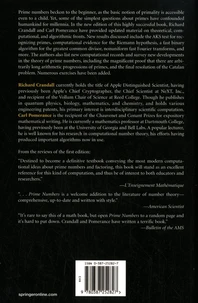
Richard Crandall currently holds the title of Apple Distinguished Scientist, having previously been Apple's Chief Cryptographer, the Chief Scientist at NeXT, Inc., and recipient of the Volum Chair of Science at Reed College. His primary interest is interdisciplinary scientific computation, though lie bas authored numerous theoretical papers in quantum physics, biology, mathematics, and chemistry as well as various patents across engineering fields.
Carl Pomerance received his Ph.D. in mathematics from Harvard University in 1972. Currently, lie is Research Professor Emeritus at the University of Georgia and a Member of Technical Staff at Bell Laboratories-Lucent Technologies. A popular lecturer and winner of the Chauvenet Prize for expository mathematical writing, Pomerance is well known for his research in computational number theory, his efforts having produced important algorithms now in wide use.
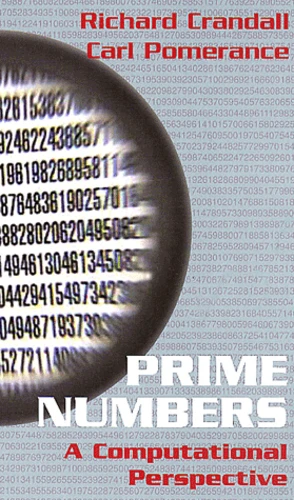
Prime Numbers. A Computational Perspective
Par : ,Formats :
- Paiement en ligne :
- Livraison à domicile ou en point Mondial Relay estimée à partir du 12 octobreCet article sera commandé chez un fournisseur et vous sera envoyé 25 jours après la date de votre commande.
- Retrait Click and Collect en magasin gratuit
- Réservation en ligne avec paiement en magasin :
- Indisponible pour réserver et payer en magasin
- Nombre de pages545
- PrésentationRelié
- Poids0.93 kg
- Dimensions16,2 cm × 24,3 cm × 3,1 cm
- ISBN0-387-94777-9
- EAN9780387947778
- Date de parution19/04/2001
- ÉditeurSpringer
Résumé
Prime numbers beckon to the beginner, the basic notion of primality being accessible a child. Yet, some of the simplest questions about primes have stumped humankind for millennia. In this book, the authors concentrate on the computational aspects of prime numbers, such as recognizing primes and discovering the fundamental prime factors of a given number. Over 100 explicit algorithms cast in detailed pseudocode are included in the book. Applications and theoretical digressions serve to illuminate, justify, and underscore the practical power of these algorithms.
This book can be read on several levels. For those wanting a taste of the lore of prime numbers and the principal methods to deal with them, the book provides a friendly introduction. For those wanting to delve deeper into the essential details of the most up-to-date methods for prime number computations, the book bas such details and many references to the huge literature on the subject. Students can test their understanding with interesting exercises, including some entertaining, nonstandard ones. And for those wishing to start or enrich a research program in computational prime number theory, the many unsolved problems in the text, and research problems in the exercises, provide rich ground for further work.