James R. Hartwell writes practical nonfiction on business, strategy, and personal growth. His work turns complex ideas into clear, useful insights for modern readers.
Nouveauté
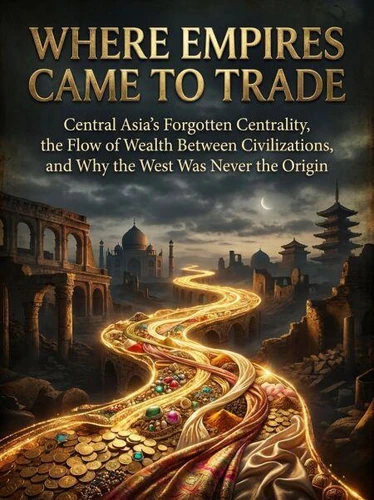
Where Empires Came to Trade. Central Asia's Forgotten Centrality, the Flow of Wealth Between Civilizations, and Why the West Was Never the Origin
Par :Formats :
Disponible dans votre compte client Decitre ou Furet du Nord dès validation de votre commande. Le format ePub est :
- Compatible avec une lecture sur My Vivlio (smartphone, tablette, ordinateur)
- Compatible avec une lecture sur liseuses Vivlio
- Pour les liseuses autres que Vivlio, vous devez utiliser le logiciel Adobe Digital Edition. Non compatible avec la lecture sur les liseuses Kindle, Remarkable et Sony
 , qui est-ce ?
Notre partenaire de plateforme de lecture numérique où vous retrouverez l'ensemble de vos ebooks gratuitement
Pour en savoir plus sur nos ebooks, consultez notre aide en ligne ici
C'est si simple ! Lisez votre ebook avec l'app Vivlio sur votre tablette, mobile ou ordinateur :

- Nombre de pages525
- FormatePub
- ISBN978-3-565-63530-6
- EAN9783565635306
- Date de parution11/08/2026
- Protection num.pas de protection
- Taille1 Mo
- Infos supplémentairesepub
- ÉditeurEmphaloz Publishing House
Résumé
History taught in Western classrooms begins at the wrong address. The cities that generated the world's greatest accumulations of gold, silver, and intellectual capital for a thousand years were not in Rome, Paris, or London - they were in Samarkand, Merv, Baghdad, and Kashgar. The Silk Roads were not a romantic footnote to European history; they were the main event.
The network of overland and maritime routes crossing Central Asia functioned as the world's primary economic engine from antiquity through the early modern period.
Silk moved westward; silver and gold moved eastward. The balance of trade did not favor Europe - it flowed toward Asia, and the wealth that eventually financed Western expansion was itself a downstream consequence of centuries of Eastern commercial vitality. Understanding how these circuits operated means rethinking not only medieval economics, but the origins of capitalism itself. The same corridors that carried commodities also carried convictions.
Buddhism reached Central Asia and China through merchant networks. Nestorian Christianity established deep roots across Persia and into Tang Dynasty China long before European missionaries reached Asia's shores. Islam spread not only through conquest but through the mercantile trust of bazaar communities from Morocco to Malacca.
Silk moved westward; silver and gold moved eastward. The balance of trade did not favor Europe - it flowed toward Asia, and the wealth that eventually financed Western expansion was itself a downstream consequence of centuries of Eastern commercial vitality. Understanding how these circuits operated means rethinking not only medieval economics, but the origins of capitalism itself. The same corridors that carried commodities also carried convictions.
Buddhism reached Central Asia and China through merchant networks. Nestorian Christianity established deep roots across Persia and into Tang Dynasty China long before European missionaries reached Asia's shores. Islam spread not only through conquest but through the mercantile trust of bazaar communities from Morocco to Malacca.