Nouveauté
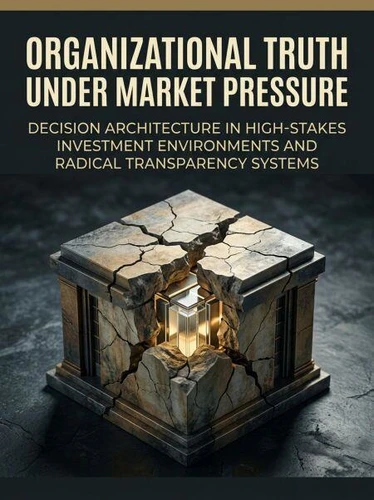
Organizational Truth Under Market Pressure. Decision Architecture in High-Stakes Investment Environments and Radical Transparency Systems
Par :Formats :
Disponible dans votre compte client Decitre ou Furet du Nord dès validation de votre commande. Le format ePub est :
- Compatible avec une lecture sur My Vivlio (smartphone, tablette, ordinateur)
- Compatible avec une lecture sur liseuses Vivlio
- Pour les liseuses autres que Vivlio, vous devez utiliser le logiciel Adobe Digital Edition. Non compatible avec la lecture sur les liseuses Kindle, Remarkable et Sony
 , qui est-ce ?
Notre partenaire de plateforme de lecture numérique où vous retrouverez l'ensemble de vos ebooks gratuitement
Pour en savoir plus sur nos ebooks, consultez notre aide en ligne ici
C'est si simple ! Lisez votre ebook avec l'app Vivlio sur votre tablette, mobile ou ordinateur :

- Nombre de pages675
- FormatePub
- ISBN978-3-565-60238-4
- EAN9783565602384
- Date de parution30/07/2026
- Protection num.pas de protection
- Taille1 Mo
- Infos supplémentairesepub
- ÉditeurEmphaloz Publishing House
Résumé
Most organizations claim they value truth, yet few design systems that force its emergence under pressure. Investment firms operating at global scale face a distinct problem: decisions must be both rapid and correct, often with incomplete information and asymmetric consequences. The gap between stated principle and operational reality becomes measurably expensive.
Radical transparency as an organizational operating system creates friction by design.
It exposes decision-making processes to continuous scrutiny, transforming subjective judgment into documented reasoning that can be tested, challenged, and refined. This approach treats principles not as cultural values but as algorithmic inputs-testable rules that govern resource allocation, personnel evaluation, and strategic positioning. The system works only when principle application is non-negotiable, even when uncomfortable. For firms competing in environments where information asymmetry determines survival, the ability to institutionalize learning from failure becomes structural advantage.
European investment management faces regulatory complexity and cultural expectations around risk disclosure that American models often underestimate. Transparency systems must account for stakeholder diversity, legal frameworks, and the reputational cost of visible error.
It exposes decision-making processes to continuous scrutiny, transforming subjective judgment into documented reasoning that can be tested, challenged, and refined. This approach treats principles not as cultural values but as algorithmic inputs-testable rules that govern resource allocation, personnel evaluation, and strategic positioning. The system works only when principle application is non-negotiable, even when uncomfortable. For firms competing in environments where information asymmetry determines survival, the ability to institutionalize learning from failure becomes structural advantage.
European investment management faces regulatory complexity and cultural expectations around risk disclosure that American models often underestimate. Transparency systems must account for stakeholder diversity, legal frameworks, and the reputational cost of visible error.