James R. Hartwell writes practical nonfiction on business, strategy, and personal growth. His work turns complex ideas into clear, useful insights for modern readers.
Nouveauté
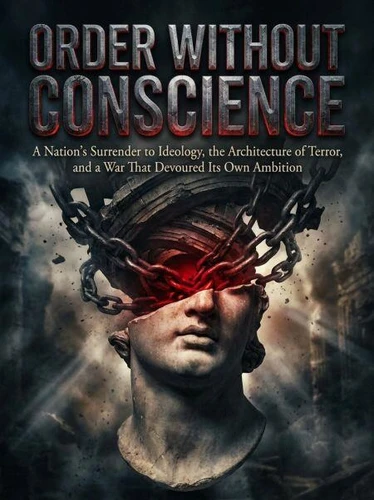
Order Without Conscience. A Nation's Surrender to Ideology, the Architecture of Terror, and a War That Devoured Its Own Ambition
Par :Formats :
Disponible dans votre compte client Decitre ou Furet du Nord dès validation de votre commande. Le format ePub est :
- Compatible avec une lecture sur My Vivlio (smartphone, tablette, ordinateur)
- Compatible avec une lecture sur liseuses Vivlio
- Pour les liseuses autres que Vivlio, vous devez utiliser le logiciel Adobe Digital Edition. Non compatible avec la lecture sur les liseuses Kindle, Remarkable et Sony
 , qui est-ce ?
Notre partenaire de plateforme de lecture numérique où vous retrouverez l'ensemble de vos ebooks gratuitement
Pour en savoir plus sur nos ebooks, consultez notre aide en ligne ici
C'est si simple ! Lisez votre ebook avec l'app Vivlio sur votre tablette, mobile ou ordinateur :

- Nombre de pages675
- FormatePub
- ISBN978-3-565-63497-2
- EAN9783565634972
- Date de parution11/08/2026
- Protection num.pas de protection
- Taille1 Mo
- Infos supplémentairesepub
- ÉditeurEmphaloz Publishing House
Résumé
Germany did not become a dictatorship overnight. It became one through a series of institutional surrenders - each one rationalized, each one seemingly reversible - until the mechanisms of self-correction no longer existed. The Weimar Republic had not merely failed as a political experiment; it had been systematically dismantled from within, its legal vocabulary turned against itself, its democratic instruments weaponized by those who had always despised what they represented.
By the time the last constitutional safeguards were abandoned, the architecture of totalitarian rule had already been quietly assembled in their place. What made the National Socialist state particularly modern in its horror was not its brutality alone, but its bureaucratic precision. Propaganda under Goebbels did not simply distort reality - it replaced it with a coherent alternative, one that rewarded conformity and made dissent feel not merely dangerous but socially illegible.
The Gestapo's power rested less on its actual size than on the culture of denunciation it cultivated: a society in which neighbors, colleagues, and family members became instruments of surveillance. Civil liberties were not abolished in a single decree; they were hollowed out incrementally, each legal maneuver accompanied by its own justification, until the citizen had no standing from which to object. At the center of the military catastrophe lay a command structure deformed by ideological certainty.
By the time the last constitutional safeguards were abandoned, the architecture of totalitarian rule had already been quietly assembled in their place. What made the National Socialist state particularly modern in its horror was not its brutality alone, but its bureaucratic precision. Propaganda under Goebbels did not simply distort reality - it replaced it with a coherent alternative, one that rewarded conformity and made dissent feel not merely dangerous but socially illegible.
The Gestapo's power rested less on its actual size than on the culture of denunciation it cultivated: a society in which neighbors, colleagues, and family members became instruments of surveillance. Civil liberties were not abolished in a single decree; they were hollowed out incrementally, each legal maneuver accompanied by its own justification, until the citizen had no standing from which to object. At the center of the military catastrophe lay a command structure deformed by ideological certainty.