James R. Hartwell writes practical nonfiction on business, strategy, and personal growth. His work turns complex ideas into clear, useful insights for modern readers.
Nouveauté
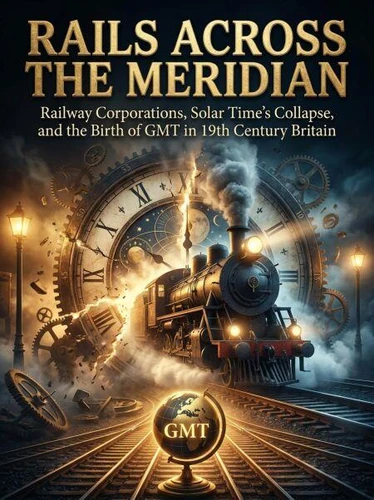
Rails Across the Meridian. Railway Corporations, Solar Time's Collapse, and the Birth of GMT in 19th Century Britain
Par :Formats :
Disponible dans votre compte client Decitre ou Furet du Nord dès validation de votre commande. Le format ePub est :
- Compatible avec une lecture sur My Vivlio (smartphone, tablette, ordinateur)
- Compatible avec une lecture sur liseuses Vivlio
- Pour les liseuses autres que Vivlio, vous devez utiliser le logiciel Adobe Digital Edition. Non compatible avec la lecture sur les liseuses Kindle, Remarkable et Sony
 , qui est-ce ?
Notre partenaire de plateforme de lecture numérique où vous retrouverez l'ensemble de vos ebooks gratuitement
Pour en savoir plus sur nos ebooks, consultez notre aide en ligne ici
C'est si simple ! Lisez votre ebook avec l'app Vivlio sur votre tablette, mobile ou ordinateur :

- Nombre de pages177
- FormatePub
- ISBN978-3-565-63098-1
- EAN9783565630981
- Date de parution10/08/2026
- Protection num.pas de protection
- Taille1 Mo
- Infos supplémentairesepub
- ÉditeurEmphaloz Publishing House
Résumé
Before the locomotive, every town kept its own clock - Bristol ran ten minutes behind London, and no authority on earth demanded otherwise. When the Great Western Railway began publishing unified timetables in the 1840s, it did not merely coordinate trains; it initiated the slow, coercive erasure of a thousand years of local solar reckoning.
The pressure came not from governments but from corporations.
Railway companies could not print reliable schedules across regions where every station kept its own noon. Collisions occurred. Passengers missed connections. The administrative machinery of industrial capitalism demanded a single measurable unit of time, and it fell to engineers and lobbyists - not astronomers - to force the question into law. By 1847, the Railway Clearing House had recommended Greenwich Mean Time for all British lines.
Parliament resisted for decades, and localities refused to surrender their sundials. The legal imposition of standard time in Britain came only in 1880. Four years later, delegates at the International Meridian Conference in Washington accepted Greenwich as the world's prime meridian, dividing the globe into twenty-four zones of enforced uniformity. What had begun as a scheduling inconvenience became the founding act of modern synchronized civilization. This history examines time standardization as a function of industrial power - not as scientific progress, but as corporate necessity institutionalized into international treaty.
Railway companies could not print reliable schedules across regions where every station kept its own noon. Collisions occurred. Passengers missed connections. The administrative machinery of industrial capitalism demanded a single measurable unit of time, and it fell to engineers and lobbyists - not astronomers - to force the question into law. By 1847, the Railway Clearing House had recommended Greenwich Mean Time for all British lines.
Parliament resisted for decades, and localities refused to surrender their sundials. The legal imposition of standard time in Britain came only in 1880. Four years later, delegates at the International Meridian Conference in Washington accepted Greenwich as the world's prime meridian, dividing the globe into twenty-four zones of enforced uniformity. What had begun as a scheduling inconvenience became the founding act of modern synchronized civilization. This history examines time standardization as a function of industrial power - not as scientific progress, but as corporate necessity institutionalized into international treaty.