James R. Hartwell writes practical nonfiction on business, strategy, and personal growth. His work turns complex ideas into clear, useful insights for modern readers.
Nouveauté
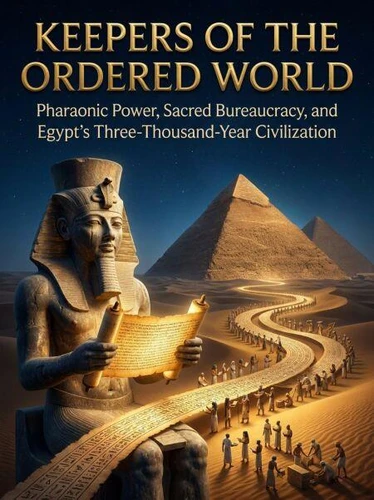
Keepers of the Ordered World. Pharaonic Power, Sacred Bureaucracy, and Egypt's Three-Thousand-Year Civilization
Par :Formats :
Disponible dans votre compte client Decitre ou Furet du Nord dès validation de votre commande. Le format ePub est :
- Compatible avec une lecture sur My Vivlio (smartphone, tablette, ordinateur)
- Compatible avec une lecture sur liseuses Vivlio
- Pour les liseuses autres que Vivlio, vous devez utiliser le logiciel Adobe Digital Edition. Non compatible avec la lecture sur les liseuses Kindle, Remarkable et Sony
 , qui est-ce ?
Notre partenaire de plateforme de lecture numérique où vous retrouverez l'ensemble de vos ebooks gratuitement
Pour en savoir plus sur nos ebooks, consultez notre aide en ligne ici
C'est si simple ! Lisez votre ebook avec l'app Vivlio sur votre tablette, mobile ou ordinateur :

- Nombre de pages592
- FormatePub
- ISBN978-3-565-63480-4
- EAN9783565634804
- Date de parution11/08/2026
- Protection num.pas de protection
- Taille1 Mo
- Infos supplémentairesepub
- ÉditeurEmphaloz Publishing House
Résumé
Egypt did not endure for three thousand years because its rulers were divine. It endured because divinity was made functional - woven into administrative systems, flood calendars, and stone that outlasted every dynasty that commissioned it. To understand ancient Egypt is to understand how a civilization converted cosmic theology into a workable machinery of state, and how long that machinery could run before it finally broke.
The pharaoh stood at the intersection of two worlds.
As the earthly guarantor of Ma'at - the principle of cosmic order, justice, and proportion - he was not merely a king claiming religious authority. He was the mechanism through which the universe was kept from collapse. Every ritual performed, every temple funded, every grain census ordered was simultaneously a political act and a theological obligation. The genius of the system was that these two categories were indistinguishable.
Rebellion against the crown was not civil disobedience - it was cosmological disruption. Beneath this theological architecture lay a bureaucratic state of remarkable sophistication. The Nile's annual flood cycle demanded an administrative infrastructure capable of measuring, predicting, and distributing water and agricultural yield across a narrow ribbon of arable land flanked by desert.
As the earthly guarantor of Ma'at - the principle of cosmic order, justice, and proportion - he was not merely a king claiming religious authority. He was the mechanism through which the universe was kept from collapse. Every ritual performed, every temple funded, every grain census ordered was simultaneously a political act and a theological obligation. The genius of the system was that these two categories were indistinguishable.
Rebellion against the crown was not civil disobedience - it was cosmological disruption. Beneath this theological architecture lay a bureaucratic state of remarkable sophistication. The Nile's annual flood cycle demanded an administrative infrastructure capable of measuring, predicting, and distributing water and agricultural yield across a narrow ribbon of arable land flanked by desert.