A writer of structured nonfiction that turns history, strategy, and self-improvement into useful ideas for modern readers.
Nouveauté
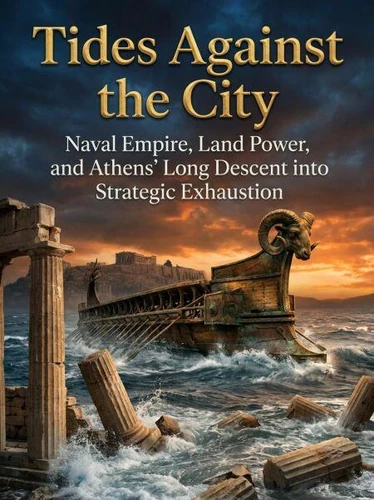
Tides Against the City. Naval Empire, Land Power, and Athens' Long Descent into Strategic Exhaustion
Par :Formats :
Disponible dans votre compte client Decitre ou Furet du Nord dès validation de votre commande. Le format ePub est :
- Compatible avec une lecture sur My Vivlio (smartphone, tablette, ordinateur)
- Compatible avec une lecture sur liseuses Vivlio
- Pour les liseuses autres que Vivlio, vous devez utiliser le logiciel Adobe Digital Edition. Non compatible avec la lecture sur les liseuses Kindle, Remarkable et Sony
 , qui est-ce ?
Notre partenaire de plateforme de lecture numérique où vous retrouverez l'ensemble de vos ebooks gratuitement
Pour en savoir plus sur nos ebooks, consultez notre aide en ligne ici
C'est si simple ! Lisez votre ebook avec l'app Vivlio sur votre tablette, mobile ou ordinateur :

- Nombre de pages476
- FormatePub
- ISBN978-3-565-63522-1
- EAN9783565635221
- Date de parution11/08/2026
- Protection num.pas de protection
- Taille1 Mo
- Infos supplémentairesepub
- ÉditeurEmphaloz Publishing House
Résumé
Athens had built an empire on water. Its fleet was not merely a military instrument - it was the material expression of a political identity, the projection of a democratic city-state's will across the Aegean. When Sparta moved against it, the confrontation was never simply between two armies. It was between two incompatible visions of how power should be organized, legitimized, and sustained. What followed was not a war decided by a single campaign or a single failure.
It was a systemic unraveling, twenty-seven years in the making, played out across sea lanes, diplomatic chambers, and the interior of a walled city slowly consuming itself. The political architecture of this conflict carried its own logic. Athenian democracy was structurally dependent on empire - on tribute from the Delian League, on commercial access, on a naval presence that doubled as an economic lifeline.
Sparta's oligarchic land power required no such extension. Its strength was internal, conservative, and indifferent to maritime commerce. These were not merely rival city-states. They were rival systems, and every treaty they signed exposed the impossibility of permanent coexistence. The Peace of Nicias, drafted in 421 BCE, did not end the war - it suspended it long enough for both sides to accumulate grievances the agreement had no mechanism to resolve. Into this structural stalemate entered a third force whose role is rarely given its full weight: Persian gold.
It was a systemic unraveling, twenty-seven years in the making, played out across sea lanes, diplomatic chambers, and the interior of a walled city slowly consuming itself. The political architecture of this conflict carried its own logic. Athenian democracy was structurally dependent on empire - on tribute from the Delian League, on commercial access, on a naval presence that doubled as an economic lifeline.
Sparta's oligarchic land power required no such extension. Its strength was internal, conservative, and indifferent to maritime commerce. These were not merely rival city-states. They were rival systems, and every treaty they signed exposed the impossibility of permanent coexistence. The Peace of Nicias, drafted in 421 BCE, did not end the war - it suspended it long enough for both sides to accumulate grievances the agreement had no mechanism to resolve. Into this structural stalemate entered a third force whose role is rarely given its full weight: Persian gold.