A writer of structured nonfiction that turns history, strategy, and self-improvement into useful ideas for modern readers.
Nouveauté
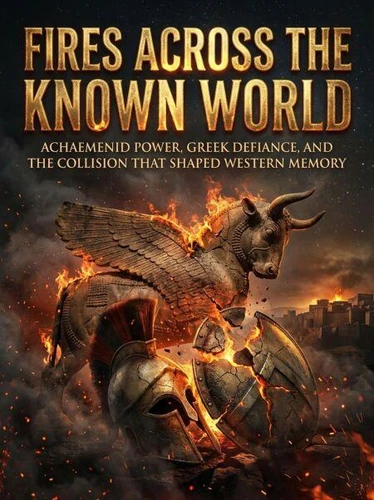
Fires Across the Known World. Achaemenid Power, Greek Defiance, and the Collision That Shaped Western Memory
Par :Formats :
Disponible dans votre compte client Decitre ou Furet du Nord dès validation de votre commande. Le format ePub est :
- Compatible avec une lecture sur My Vivlio (smartphone, tablette, ordinateur)
- Compatible avec une lecture sur liseuses Vivlio
- Pour les liseuses autres que Vivlio, vous devez utiliser le logiciel Adobe Digital Edition. Non compatible avec la lecture sur les liseuses Kindle, Remarkable et Sony
 , qui est-ce ?
Notre partenaire de plateforme de lecture numérique où vous retrouverez l'ensemble de vos ebooks gratuitement
Pour en savoir plus sur nos ebooks, consultez notre aide en ligne ici
C'est si simple ! Lisez votre ebook avec l'app Vivlio sur votre tablette, mobile ou ordinateur :

- Nombre de pages548
- FormatePub
- ISBN978-3-565-63463-7
- EAN9783565634637
- Date de parution11/08/2026
- Protection num.pas de protection
- Taille1 Mo
- Infos supplémentairesepub
- ÉditeurEmphaloz Publishing House
Résumé
Xerxes did not cross the Hellespont simply to punish Athens. He crossed it to demonstrate something far more fundamental - that no corner of the inhabited world lay beyond the reach of Achaemenid order. The Persian Empire that marched westward in 480 BCE was the largest administrative structure the ancient world had yet produced, a multiethnic dominion stretching from the Indus valley to the Nile delta, held together not by brute uniformity but by a sophisticated system of governed difference.
Understanding why that empire came so close to absorbing Greece - and why it ultimately could not - requires looking beyond battlefield drama toward the structural logic of two irreconcilable political civilizations meeting at their outer limit. The Achaemenid satrapy system was an exercise in institutional imagination. Provincial governors were granted real administrative authority while remaining bound to the imperial center through tribute obligations, royal inspectors, and the ideological framework of Ahura Mazda's cosmic order.
Egypt retained its priesthoods, Babylon its legal traditions, Lydia its aristocracies - all functioning within a hierarchy that demanded loyalty without demanding cultural erasure. It was precisely this flexibility that made Persian expansion so effective, and precisely this flexibility that the Greek city-states had no equivalent apparatus to counter diplomatically. What the poleis could not match institutionally, they exploited militarily.
Understanding why that empire came so close to absorbing Greece - and why it ultimately could not - requires looking beyond battlefield drama toward the structural logic of two irreconcilable political civilizations meeting at their outer limit. The Achaemenid satrapy system was an exercise in institutional imagination. Provincial governors were granted real administrative authority while remaining bound to the imperial center through tribute obligations, royal inspectors, and the ideological framework of Ahura Mazda's cosmic order.
Egypt retained its priesthoods, Babylon its legal traditions, Lydia its aristocracies - all functioning within a hierarchy that demanded loyalty without demanding cultural erasure. It was precisely this flexibility that made Persian expansion so effective, and precisely this flexibility that the Greek city-states had no equivalent apparatus to counter diplomatically. What the poleis could not match institutionally, they exploited militarily.