A writer of structured nonfiction that turns history, strategy, and self-improvement into useful ideas for modern readers.
Nouveauté
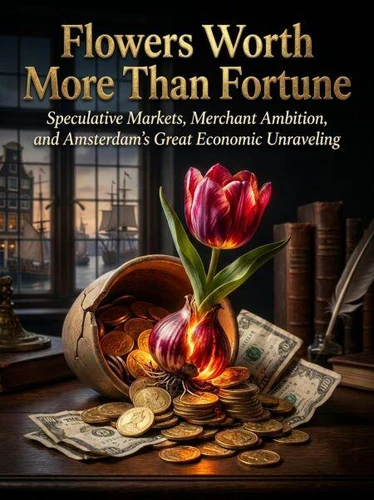
Flowers Worth More Than Fortune. Speculative Markets, Merchant Ambition, and Amsterdam's Great Economic Unraveling
Par :Formats :
Disponible dans votre compte client Decitre ou Furet du Nord dès validation de votre commande. Le format ePub est :
- Compatible avec une lecture sur My Vivlio (smartphone, tablette, ordinateur)
- Compatible avec une lecture sur liseuses Vivlio
- Pour les liseuses autres que Vivlio, vous devez utiliser le logiciel Adobe Digital Edition. Non compatible avec la lecture sur les liseuses Kindle, Remarkable et Sony
 , qui est-ce ?
Notre partenaire de plateforme de lecture numérique où vous retrouverez l'ensemble de vos ebooks gratuitement
Pour en savoir plus sur nos ebooks, consultez notre aide en ligne ici
C'est si simple ! Lisez votre ebook avec l'app Vivlio sur votre tablette, mobile ou ordinateur :

- Nombre de pages174
- FormatePub
- ISBN978-3-565-63082-0
- EAN9783565630820
- Date de parution10/08/2026
- Protection num.pas de protection
- Taille940 Ko
- Infos supplémentairesepub
- ÉditeurEmphaloz Publishing House
Résumé
In the winter of 1636, a single bulb of the Semper Augustus tulip commanded a price exceeding ten times the annual wage of a skilled Amsterdam craftsman - before the market collapsed in February 1637, leaving contracts worthless and futures traders unable to settle debts. What happened in the Dutch Republic was not mere hysteria. It was the inaugural crisis of a modern financial system, complete with futures contracts, leveraged buyers, and the psychological architecture of a market that had divorced value from substance.
Tulip Mania emerged from conditions specific to the Dutch Golden Age: an extraordinary concentration of merchant wealth, an established commodity exchange in Amsterdam, and a Protestant culture that sanctified commercial ambition as civic virtue.
The tulip - imported from Ottoman Turkey less than a century earlier - became a luxury signal, its rarity amplified by the mosaic virus that produced the most prized broken-color varieties. When informal tavern trading evolved into a system of futures contracts, speculation was no longer limited to merchants with capital. Artisans, weavers, and minor tradesmen entered the market with borrowed money, purchasing bulbs they had never seen and would never plant. The crash of February 1637 exposed the fragility of a market built on social consensus rather than legal enforcement.
Haarlem courts refused to adjudicate unpaid contracts, classifying them as gambling debts. The satirical pamphlets that followed - Floraes Sot-Boeck among them - documented a society simultaneously horrified and fascinated by what collective credulity had built. As the first documented speculative bubble in market history, Tulip Mania remains a foundational case in the study of financial psychology, commodity fetishism, and the conditions under which price detaches from all rational valuation.
The tulip - imported from Ottoman Turkey less than a century earlier - became a luxury signal, its rarity amplified by the mosaic virus that produced the most prized broken-color varieties. When informal tavern trading evolved into a system of futures contracts, speculation was no longer limited to merchants with capital. Artisans, weavers, and minor tradesmen entered the market with borrowed money, purchasing bulbs they had never seen and would never plant. The crash of February 1637 exposed the fragility of a market built on social consensus rather than legal enforcement.
Haarlem courts refused to adjudicate unpaid contracts, classifying them as gambling debts. The satirical pamphlets that followed - Floraes Sot-Boeck among them - documented a society simultaneously horrified and fascinated by what collective credulity had built. As the first documented speculative bubble in market history, Tulip Mania remains a foundational case in the study of financial psychology, commodity fetishism, and the conditions under which price detaches from all rational valuation.