A writer of structured nonfiction that turns history, strategy, and self-improvement into useful ideas for modern readers.
Nouveauté
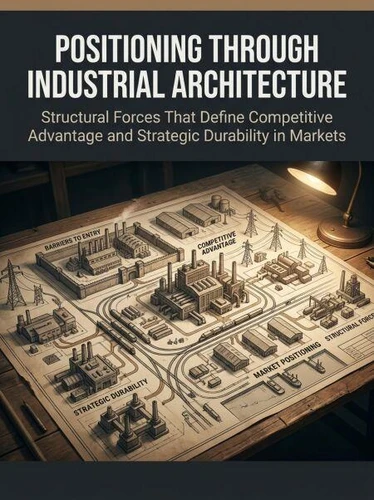
Positioning Through Industrial Architecture. Structural Forces That Define Competitive Advantage and Strategic Durability in Markets
Par :Formats :
Disponible dans votre compte client Decitre ou Furet du Nord dès validation de votre commande. Le format ePub est :
- Compatible avec une lecture sur My Vivlio (smartphone, tablette, ordinateur)
- Compatible avec une lecture sur liseuses Vivlio
- Pour les liseuses autres que Vivlio, vous devez utiliser le logiciel Adobe Digital Edition. Non compatible avec la lecture sur les liseuses Kindle, Remarkable et Sony
 , qui est-ce ?
Notre partenaire de plateforme de lecture numérique où vous retrouverez l'ensemble de vos ebooks gratuitement
Pour en savoir plus sur nos ebooks, consultez notre aide en ligne ici
C'est si simple ! Lisez votre ebook avec l'app Vivlio sur votre tablette, mobile ou ordinateur :

- Nombre de pages561
- FormatePub
- ISBN978-3-565-60242-1
- EAN9783565602421
- Date de parution30/07/2026
- Protection num.pas de protection
- Taille1 Mo
- Infos supplémentairesepub
- ÉditeurEmphaloz Publishing House
Résumé
Most companies misread competition by focusing on rivals instead of the forces that shape profitability across entire industries. Competitive advantage emerges not from operational intensity but from understanding how supplier power, buyer leverage, substitution threats, entry barriers, and rivalry interact to compress or expand strategic room.
This book deconstructs the Five Forces framework as a diagnostic tool for mapping structural positions.
It explains why some industries sustain high returns while others commoditize rapidly, how barriers erode under technological or regulatory shifts, and where firms can reposition to escape zero-sum competition. The analysis moves beyond market share to examine profit pools, value chain reconfiguration, and the conditions under which differentiation or cost leadership remains defensible. For executives operating in consolidating sectors or facing platform disruption, the framework offers a method to separate noise from structural signal.
It does not prescribe universal strategies but provides a repeatable process for evaluating whether competitive moves address surface symptoms or underlying industry economics.
It explains why some industries sustain high returns while others commoditize rapidly, how barriers erode under technological or regulatory shifts, and where firms can reposition to escape zero-sum competition. The analysis moves beyond market share to examine profit pools, value chain reconfiguration, and the conditions under which differentiation or cost leadership remains defensible. For executives operating in consolidating sectors or facing platform disruption, the framework offers a method to separate noise from structural signal.
It does not prescribe universal strategies but provides a repeatable process for evaluating whether competitive moves address surface symptoms or underlying industry economics.