A writer of structured nonfiction that turns history, strategy, and self-improvement into useful ideas for modern readers.
Nouveauté
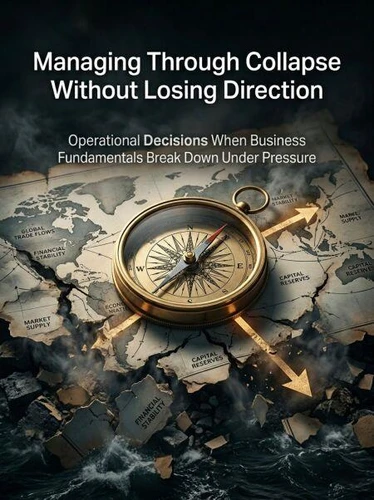
Managing Through Collapse Without Losing Direction. Operational Decisions When Business Fundamentals Break Down Under Pressure
Par :Formats :
Disponible dans votre compte client Decitre ou Furet du Nord dès validation de votre commande. Le format ePub est :
- Compatible avec une lecture sur My Vivlio (smartphone, tablette, ordinateur)
- Compatible avec une lecture sur liseuses Vivlio
- Pour les liseuses autres que Vivlio, vous devez utiliser le logiciel Adobe Digital Edition. Non compatible avec la lecture sur les liseuses Kindle, Remarkable et Sony
 , qui est-ce ?
Notre partenaire de plateforme de lecture numérique où vous retrouverez l'ensemble de vos ebooks gratuitement
Pour en savoir plus sur nos ebooks, consultez notre aide en ligne ici
C'est si simple ! Lisez votre ebook avec l'app Vivlio sur votre tablette, mobile ou ordinateur :

- Nombre de pages525
- FormatePub
- ISBN978-3-565-60232-2
- EAN9783565602322
- Date de parution30/07/2026
- Protection num.pas de protection
- Taille1 Mo
- Infos supplémentairesepub
- ÉditeurEmphaloz Publishing House
Résumé
Most leadership frameworks assume stable conditions. When revenue collapses, key personnel exit, or market assumptions invert overnight, those frameworks offer little guidance. The operational reality of extreme business stress is not a test of vision or charisma-it is a test of decision architecture under conditions of incomplete information and compounding consequences.
This examination focuses on three structural challenges: the mechanics of workforce reduction when personal relationships intersect with fiduciary responsibility, the behavioral dynamics of team morale during prolonged uncertainty, and the resource allocation decisions required to maintain organizational coherence when traditional performance metrics no longer apply.
Each scenario reveals how leadership operates as a function of constraint management rather than strategic inspiration. For executives and operators navigating contraction, restructuring, or market dislocation, the core question is not whether to act but how to preserve decision quality when every option carries significant downside. The European business context-where labor law, stakeholder expectations, and cultural norms around failure differ markedly from American models-demands adapted frameworks for crisis navigation that account for structural rather than motivational variables.
Each scenario reveals how leadership operates as a function of constraint management rather than strategic inspiration. For executives and operators navigating contraction, restructuring, or market dislocation, the core question is not whether to act but how to preserve decision quality when every option carries significant downside. The European business context-where labor law, stakeholder expectations, and cultural norms around failure differ markedly from American models-demands adapted frameworks for crisis navigation that account for structural rather than motivational variables.