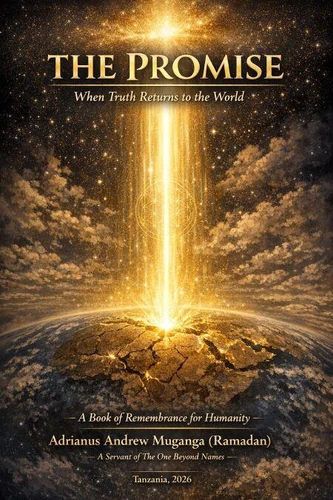
The Promise: When Truth Returns to the World. 19, #19
Par :Formats :
Disponible dans votre compte client Decitre ou Furet du Nord dès validation de votre commande. Le format ePub est :
- Compatible avec une lecture sur My Vivlio (smartphone, tablette, ordinateur)
- Compatible avec une lecture sur liseuses Vivlio
- Pour les liseuses autres que Vivlio, vous devez utiliser le logiciel Adobe Digital Edition. Non compatible avec la lecture sur les liseuses Kindle, Remarkable et Sony
 , qui est-ce ?
Notre partenaire de plateforme de lecture numérique où vous retrouverez l'ensemble de vos ebooks gratuitement
Pour en savoir plus sur nos ebooks, consultez notre aide en ligne ici
C'est si simple ! Lisez votre ebook avec l'app Vivlio sur votre tablette, mobile ou ordinateur :

- FormatePub
- ISBN978-1-105-75005-2
- EAN9781105750052
- Date de parution25/01/2026
- Protection num.pas de protection
- Infos supplémentairesepub
- ÉditeurLulu.com
Résumé
THE PROMISE: When Truth Returns to the WorldTruth was never destroyed. It was displaced. The Promise is not a religion, doctrine, or manifesto. It does not ask for belief or allegiance. It asks only for attention. The book examines how truth was removed from direct human experience and replaced by systems of authority, doctrine, and control that claimed the right to define reality. Through historical and comparative analysis, the work traces a long shift in human orientation: from inner knowing to obedience, from lived alignment to inherited belief, and from awareness to fear as a stabilizing force.
Institutions originally formed to preserve wisdom gradually became structures that replaced what they claimed to protect. Over time, truth was externalized, administered, and owned, while consciousness was discouraged in favor of compliance. The book explores how this pattern appeared across civilizations, religions, and empires, including the spiritual dimension of colonial systems that reorganized memory, legitimacy, and identity.
Colonization is examined not only as political domination, but as a restructuring of perception that severed people from their own historical and spiritual continuity. The Promise argues that contemporary global instability, political, cultural, economic, and psychological, is not accidental. It is the consequence of a long misalignment between truth and power. As belief erodes, systems dependent on it begin to fracture internally before they collapse visibly.
What distinguishes the present moment is not crisis alone, but exposure. Across cultures and traditions, moments of total distortion are accompanied by a shared remembrance: when illusion dominates completely, truth returns without permission. Sometimes described as a figure, sometimes as awakening, judgment, or renewal, the form differs, but the function remains the same. This return is not the arrival of a new authority, doctrine, or hierarchy, but the exposure of structures that can no longer sustain concealment.
The book does not propose a new system to replace the old. It does not offer instruction, prophecy, or leadership. Instead, it points toward a reorientation in which truth is restored as lived alignment rather than external command, faith exists without fear, and responsibility returns to direct human awareness. The Promise is written for readers who sense that something foundational is misaligned beneath the surface of the modern world.
It does not persuade or argue. It clarifies patterns that, once recognized, cannot be unseen. What follows is not a conclusion, but a threshold-an invitation to remember rather than believe.
Institutions originally formed to preserve wisdom gradually became structures that replaced what they claimed to protect. Over time, truth was externalized, administered, and owned, while consciousness was discouraged in favor of compliance. The book explores how this pattern appeared across civilizations, religions, and empires, including the spiritual dimension of colonial systems that reorganized memory, legitimacy, and identity.
Colonization is examined not only as political domination, but as a restructuring of perception that severed people from their own historical and spiritual continuity. The Promise argues that contemporary global instability, political, cultural, economic, and psychological, is not accidental. It is the consequence of a long misalignment between truth and power. As belief erodes, systems dependent on it begin to fracture internally before they collapse visibly.
What distinguishes the present moment is not crisis alone, but exposure. Across cultures and traditions, moments of total distortion are accompanied by a shared remembrance: when illusion dominates completely, truth returns without permission. Sometimes described as a figure, sometimes as awakening, judgment, or renewal, the form differs, but the function remains the same. This return is not the arrival of a new authority, doctrine, or hierarchy, but the exposure of structures that can no longer sustain concealment.
The book does not propose a new system to replace the old. It does not offer instruction, prophecy, or leadership. Instead, it points toward a reorientation in which truth is restored as lived alignment rather than external command, faith exists without fear, and responsibility returns to direct human awareness. The Promise is written for readers who sense that something foundational is misaligned beneath the surface of the modern world.
It does not persuade or argue. It clarifies patterns that, once recognized, cannot be unseen. What follows is not a conclusion, but a threshold-an invitation to remember rather than believe.
A propos de Adrianus Andrew Muganga (Ramad

0,99 €

0,99 €