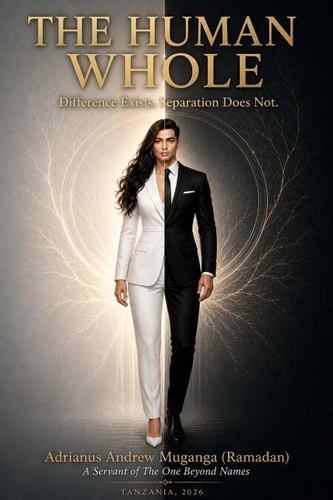
The Human Whole: Difference Exists. Separation Does Not. 35, #35
Par :Formats :
Disponible dans votre compte client Decitre ou Furet du Nord dès validation de votre commande. Le format ePub est :
- Compatible avec une lecture sur My Vivlio (smartphone, tablette, ordinateur)
- Compatible avec une lecture sur liseuses Vivlio
- Pour les liseuses autres que Vivlio, vous devez utiliser le logiciel Adobe Digital Edition. Non compatible avec la lecture sur les liseuses Kindle, Remarkable et Sony
 , qui est-ce ?
Notre partenaire de plateforme de lecture numérique où vous retrouverez l'ensemble de vos ebooks gratuitement
Pour en savoir plus sur nos ebooks, consultez notre aide en ligne ici
C'est si simple ! Lisez votre ebook avec l'app Vivlio sur votre tablette, mobile ou ordinateur :

- FormatePub
- ISBN978-1-105-34218-9
- EAN9781105342189
- Date de parution05/05/2026
- Protection num.pas de protection
- Infos supplémentairesepub
- ÉditeurLulu.com
Résumé
THE HUMAN WHOLE: Difference Exists. Separation Does Not is a civilizational work exploring the growing fragmentation of modern human life and the deeper patterns connecting humanity across psychology, relationships, family systems, ecology, technology, and society. Written during a period of accelerating technological advancement, social polarization, emotional exhaustion, ecological instability, and declining trust, the book examines how many modern crises often treated as separate are deeply interconnected beneath the surface.
Loneliness, gender conflict, family instability, psychological stress, ideological division, technological dependency, and the collapse of shared meaning are explored as expressions of a larger condition of human fragmentation. Drawing from observable patterns across biology, history, systems thinking, emotional development, and human behavior, the work argues that stable existence depends upon relationship, balance, interdependence, and continuity rather than domination, isolation, or permanent conflict.
The book explores how modern civilization increasingly conditions individuals to experience themselves primarily as isolated identities while weakening the relational foundations necessary for healthy human development and long term social stability. A major focus of the work examines the relationship between masculine and feminine realities within human existence. Rather than approaching men and women as opposing groups competing for power or moral superiority, the book explores how historical imbalance, reaction, emotional fragmentation, and ideological extremism have contributed to growing instability across relationships, families, and society itself.
The text also examines broader civilizational questions involving leadership, technology, education, economics, ecological balance, childhood development, emotional intelligence, and the future of humanity in an age of rapid transformation. Throughout the work, readers are encouraged to think independently, observe carefully, and compare every idea against lived reality rather than ideological loyalty or emotional reaction.
Part philosophy, part social analysis, and part reflection on human continuity, THE HUMAN WHOLE argues that humanity's greatest crisis may not simply be political, technological, or economic, but relational and perceptual. Its central message remains simple: difference exists naturally throughout life, but separation becomes destructive when human beings forget the deeper interconnectedness sustaining existence itself.
Loneliness, gender conflict, family instability, psychological stress, ideological division, technological dependency, and the collapse of shared meaning are explored as expressions of a larger condition of human fragmentation. Drawing from observable patterns across biology, history, systems thinking, emotional development, and human behavior, the work argues that stable existence depends upon relationship, balance, interdependence, and continuity rather than domination, isolation, or permanent conflict.
The book explores how modern civilization increasingly conditions individuals to experience themselves primarily as isolated identities while weakening the relational foundations necessary for healthy human development and long term social stability. A major focus of the work examines the relationship between masculine and feminine realities within human existence. Rather than approaching men and women as opposing groups competing for power or moral superiority, the book explores how historical imbalance, reaction, emotional fragmentation, and ideological extremism have contributed to growing instability across relationships, families, and society itself.
The text also examines broader civilizational questions involving leadership, technology, education, economics, ecological balance, childhood development, emotional intelligence, and the future of humanity in an age of rapid transformation. Throughout the work, readers are encouraged to think independently, observe carefully, and compare every idea against lived reality rather than ideological loyalty or emotional reaction.
Part philosophy, part social analysis, and part reflection on human continuity, THE HUMAN WHOLE argues that humanity's greatest crisis may not simply be political, technological, or economic, but relational and perceptual. Its central message remains simple: difference exists naturally throughout life, but separation becomes destructive when human beings forget the deeper interconnectedness sustaining existence itself.
A propos de Adrianus Andrew Muganga (Ramad
0,99 €
0,99 €