SOLDES
Jusqu'à -70% sur une sélection d'articles*

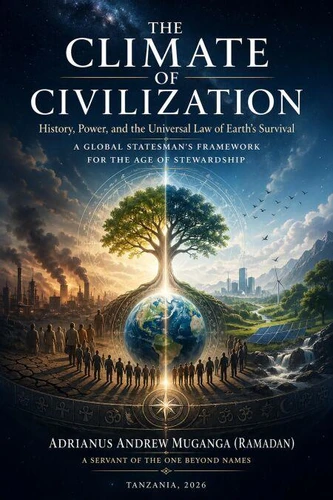
The Climate of Civilization: History, Power, and the Universal Law of Earth's Survival.. 34, #34
Par :Formats :
Disponible dans votre compte client Decitre ou Furet du Nord dès validation de votre commande. Le format ePub est :
- Compatible avec une lecture sur My Vivlio (smartphone, tablette, ordinateur)
- Compatible avec une lecture sur liseuses Vivlio
- Pour les liseuses autres que Vivlio, vous devez utiliser le logiciel Adobe Digital Edition. Non compatible avec la lecture sur les liseuses Kindle, Remarkable et Sony
 , qui est-ce ?
Notre partenaire de plateforme de lecture numérique où vous retrouverez l'ensemble de vos ebooks gratuitement
Pour en savoir plus sur nos ebooks, consultez notre aide en ligne ici
C'est si simple ! Lisez votre ebook avec l'app Vivlio sur votre tablette, mobile ou ordinateur :

- FormatePub
- ISBN978-1-105-36086-2
- EAN9781105360862
- Date de parution29/04/2026
- Protection num.pas de protection
- Infos supplémentairesepub
- ÉditeurLulu.com
Résumé
The Climate of Civilization: History, Power, and the Universal Law of Earth's Survival is a sweeping examination of the defining challenge of the twenty-first century: whether humanity can align its immense technological and economic power with the physical realities of the planet that sustains it. Climate change is not merely an environmental issue. It is a civilizational issue. It will shape energy systems, economic development, global security, migration, agriculture, infrastructure, and the strategic balance of nations for centuries to come.
Drawing upon climate science, history, economics, geopolitics, demography, and systems thinking, Adrianus Andrew Muganga traces humanity's journey from the emergence of Homo sapiens through the stability of the Holocene, the Industrial Revolution, and the rise of fossil-fuel civilization. He shows how a species once governed entirely by climate became powerful enough to alter the Earth's atmosphere, oceans, and ecological systems.
The book presents the complete climate and demographic arc from 300, 000 BCE to 2100+, revealing the mathematical relationship between population growth, carbon emissions, global temperature, and sea-level rise. It explains why climate change is the direct consequence of civilization's scale, energy systems, and institutional design. More importantly, this work moves beyond diagnosis. It offers a practical framework for planetary stewardship, outlining the technologies, policies, and institutional reforms necessary to build a prosperous, resilient, low-carbon civilization.
From renewable energy and industrial decarbonization to regenerative agriculture, ecosystem restoration, and global climate governance, it presents a comprehensive roadmap for the century ahead. Written in a rigorous, statesmanlike, and accessible style, this book is intended for policymakers, business leaders, educators, investors, students, and citizens seeking a serious understanding of the forces shaping the future.
Ultimately, The Climate of Civilization is about far more than climate alone. It is about whether humanity can mature fast enough to govern the power it has acquired. The choices made in this century will determine the stability of coastlines, ecosystems, economies, and civilizations for thousands of years. Humanity has acquired planetary power. The central question is whether it can develop planetary wisdom.
Drawing upon climate science, history, economics, geopolitics, demography, and systems thinking, Adrianus Andrew Muganga traces humanity's journey from the emergence of Homo sapiens through the stability of the Holocene, the Industrial Revolution, and the rise of fossil-fuel civilization. He shows how a species once governed entirely by climate became powerful enough to alter the Earth's atmosphere, oceans, and ecological systems.
The book presents the complete climate and demographic arc from 300, 000 BCE to 2100+, revealing the mathematical relationship between population growth, carbon emissions, global temperature, and sea-level rise. It explains why climate change is the direct consequence of civilization's scale, energy systems, and institutional design. More importantly, this work moves beyond diagnosis. It offers a practical framework for planetary stewardship, outlining the technologies, policies, and institutional reforms necessary to build a prosperous, resilient, low-carbon civilization.
From renewable energy and industrial decarbonization to regenerative agriculture, ecosystem restoration, and global climate governance, it presents a comprehensive roadmap for the century ahead. Written in a rigorous, statesmanlike, and accessible style, this book is intended for policymakers, business leaders, educators, investors, students, and citizens seeking a serious understanding of the forces shaping the future.
Ultimately, The Climate of Civilization is about far more than climate alone. It is about whether humanity can mature fast enough to govern the power it has acquired. The choices made in this century will determine the stability of coastlines, ecosystems, economies, and civilizations for thousands of years. Humanity has acquired planetary power. The central question is whether it can develop planetary wisdom.
A propos de Adrianus Andrew Muganga (Ramad






0,99 €

0,99 €