A routine disruptor who overcame chaos in his consulting days, crafting self-help habit systems, business guides for flexible operations, and historical accounts of productivity shifts in wartime economies.
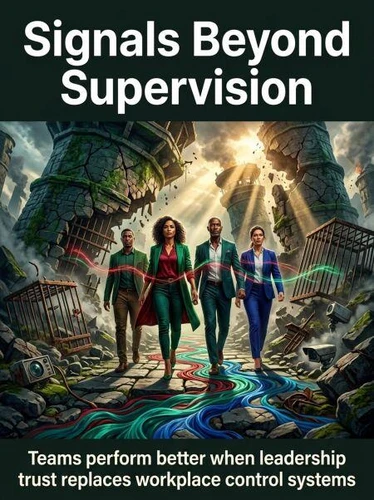
Signals Beyond Supervision. Teams perform better when leadership trust replaces workplace control systems
Par :Formats :
Disponible dans votre compte client Decitre ou Furet du Nord dès validation de votre commande. Le format ePub est :
- Compatible avec une lecture sur My Vivlio (smartphone, tablette, ordinateur)
- Compatible avec une lecture sur liseuses Vivlio
- Pour les liseuses autres que Vivlio, vous devez utiliser le logiciel Adobe Digital Edition. Non compatible avec la lecture sur les liseuses Kindle, Remarkable et Sony
 , qui est-ce ?
Notre partenaire de plateforme de lecture numérique où vous retrouverez l'ensemble de vos ebooks gratuitement
Pour en savoir plus sur nos ebooks, consultez notre aide en ligne ici
C'est si simple ! Lisez votre ebook avec l'app Vivlio sur votre tablette, mobile ou ordinateur :

- Nombre de pages191
- FormatePub
- ISBN978-3-565-48083-8
- EAN9783565480838
- Date de parution06/06/2026
- Protection num.pas de protection
- Taille1 Mo
- Infos supplémentairesepub
- ÉditeurEmphaloz Publishing House
Résumé
Leadership books for managers often focus on improving oversight, reporting, and performance tracking. Yet many organizations face the opposite problem: too much intervention. Teams slow down, decision cycles expand, and capable employees begin waiting for permission instead of solving problems.
This book examines what happens when leaders reduce unnecessary control and create conditions for autonomous execution.
Rather than treating trust as a cultural slogan, it explores trust as an operational mechanism that affects speed, ownership, and coordination. The discussion focuses on three critical areas. First, how workplace control systems unintentionally create dependency inside high-performing teams. Second, how decision-making quality improves when employees are trusted to manage uncertainty without constant managerial approval.
Third, how leaders can distinguish between necessary accountability and harmful intervention. Modern organizations rarely fail because employees lack talent. More often, execution slows because every action moves through layers of approval, correction, and supervision. The result is hidden organizational friction that weakens productivity and engagement. As European companies navigate hybrid work, cross-border collaboration, and increasing complexity, leaders face a fundamental challenge: building organizations that remain aligned without requiring constant control.
The ability to trust execution may become a greater competitive advantage than the ability to monitor it.
Rather than treating trust as a cultural slogan, it explores trust as an operational mechanism that affects speed, ownership, and coordination. The discussion focuses on three critical areas. First, how workplace control systems unintentionally create dependency inside high-performing teams. Second, how decision-making quality improves when employees are trusted to manage uncertainty without constant managerial approval.
Third, how leaders can distinguish between necessary accountability and harmful intervention. Modern organizations rarely fail because employees lack talent. More often, execution slows because every action moves through layers of approval, correction, and supervision. The result is hidden organizational friction that weakens productivity and engagement. As European companies navigate hybrid work, cross-border collaboration, and increasing complexity, leaders face a fundamental challenge: building organizations that remain aligned without requiring constant control.
The ability to trust execution may become a greater competitive advantage than the ability to monitor it.
A propos de Elton Quill




24,99 €



9,99 €