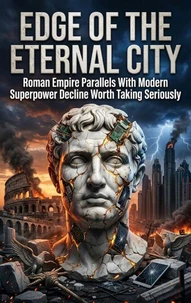
Ancient Rome projected power through monuments, military triumphs, and public ceremony. Yet beneath the marble image stood overcrowded neighborhoods, unstable housing, polluted streets, and millions dependent on fragile urban systems to survive. The empire's capital was both magnificent and deeply unequal.
This account reconstructs the realities of daily urban life in ancient Rome. Multi-story insulae housed large populations in cramped and dangerous conditions while sanitation systems struggled against fire, waste, and disease.
Public grain distribution became essential for maintaining social stability among the urban poor, tying survival directly to political authority.
The book also examines the social function of public spaces such as the Roman Forum. Markets, legal proceedings, religious rituals, and political speeches converged within shared urban environments where class divisions remained constantly visible. Patronage networks shaped access to employment, protection, and legal influence across every level of society.
Rather than portraying Rome only through emperors and conquest, the narrative reveals an urban civilization sustained by negotiation between spectacle, poverty, and political control.
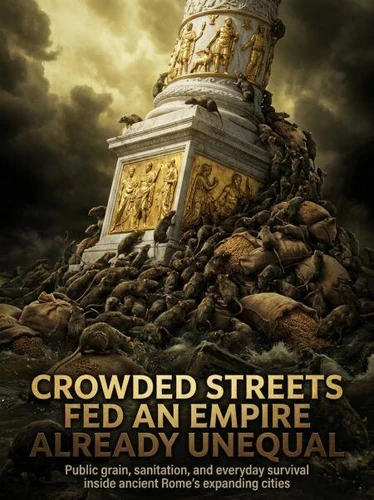
Ancient Rome projected power through monuments, military triumphs, and public ceremony. Yet beneath the marble image stood overcrowded neighborhoods, unstable housing, polluted streets, and millions dependent on fragile urban systems to survive. The empire's capital was both magnificent and deeply unequal.
This account reconstructs the realities of daily urban life in ancient Rome. Multi-story insulae housed large populations in cramped and dangerous conditions while sanitation systems struggled against fire, waste, and disease.
Public grain distribution became essential for maintaining social stability among the urban poor, tying survival directly to political authority.
The book also examines the social function of public spaces such as the Roman Forum. Markets, legal proceedings, religious rituals, and political speeches converged within shared urban environments where class divisions remained constantly visible. Patronage networks shaped access to employment, protection, and legal influence across every level of society.
Rather than portraying Rome only through emperors and conquest, the narrative reveals an urban civilization sustained by negotiation between spectacle, poverty, and political control.


 , qui est-ce ?