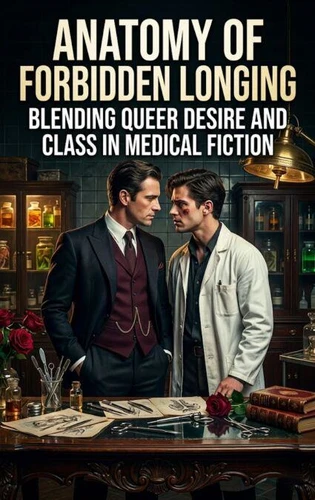
Anatomy of Forbidden Longing. Blending Queer Desire and Class in Medical Fiction
Par :Formats :
Disponible dans votre compte client Decitre ou Furet du Nord dès validation de votre commande. Le format ePub est :
- Compatible avec une lecture sur My Vivlio (smartphone, tablette, ordinateur)
- Compatible avec une lecture sur liseuses Vivlio
- Pour les liseuses autres que Vivlio, vous devez utiliser le logiciel Adobe Digital Edition. Non compatible avec la lecture sur les liseuses Kindle, Remarkable et Sony
 , qui est-ce ?
Notre partenaire de plateforme de lecture numérique où vous retrouverez l'ensemble de vos ebooks gratuitement
Pour en savoir plus sur nos ebooks, consultez notre aide en ligne ici
C'est si simple ! Lisez votre ebook avec l'app Vivlio sur votre tablette, mobile ou ordinateur :

- Nombre de pages172
- FormatePub
- ISBN978-3-565-41045-3
- EAN9783565410453
- Date de parution14/04/2026
- Protection num.pas de protection
- Taille1 Mo
- Infos supplémentairesepub
- ÉditeurEmphaloz Publishing House
Résumé
In the 19th century, European medicine did not merely study the human body - it claimed authority over desire itself. By the latter half of the century, the "homosexual" had emerged in medical literature as a distinct category of human being: a case history, a morphology, a pathology to be diagnosed, treated, and if possible, erased. Foucault observed that this new figure possessed not merely behaviors but "a past, a case history and a childhood, a character, a form of life" - and with that clinical construction came a new form of power, one exercised in consultation rooms, asylums, and hospitals across Britain and the Continent.
But medicine's authority over desire was never applied equally.
Class determined everything. A wealthy gentleman whose desires strayed from convention could afford discretion, private physicians, and the quiet management of reputation. A working-class laborer, a factory seamstress, a hospital patient with no money and no name - these were the people whose bodies were available to the medical gaze, whose "inversions" became case studies, whose suffering was published in journals and read aloud in lecture halls.
The intimate intersection of queer desire and class inequality in Victorian and Edwardian medicine produced a double vulnerability: to be poor was to be exposed; to be queer and poor was to become a specimen.
Class determined everything. A wealthy gentleman whose desires strayed from convention could afford discretion, private physicians, and the quiet management of reputation. A working-class laborer, a factory seamstress, a hospital patient with no money and no name - these were the people whose bodies were available to the medical gaze, whose "inversions" became case studies, whose suffering was published in journals and read aloud in lecture halls.
The intimate intersection of queer desire and class inequality in Victorian and Edwardian medicine produced a double vulnerability: to be poor was to be exposed; to be queer and poor was to become a specimen.