A routine disruptor who overcame chaos in his consulting days, crafting self-help habit systems, business guides for flexible operations, and historical accounts of productivity shifts in wartime economies.
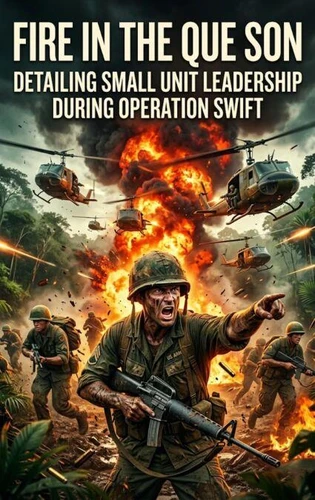
Fire in the Que Son. Detailing Small Unit Leadership during Operation Swift
Par :Formats :
Disponible dans votre compte client Decitre ou Furet du Nord dès validation de votre commande. Le format ePub est :
- Compatible avec une lecture sur My Vivlio (smartphone, tablette, ordinateur)
- Compatible avec une lecture sur liseuses Vivlio
- Pour les liseuses autres que Vivlio, vous devez utiliser le logiciel Adobe Digital Edition. Non compatible avec la lecture sur les liseuses Kindle, Remarkable et Sony
 , qui est-ce ?
Notre partenaire de plateforme de lecture numérique où vous retrouverez l'ensemble de vos ebooks gratuitement
Pour en savoir plus sur nos ebooks, consultez notre aide en ligne ici
C'est si simple ! Lisez votre ebook avec l'app Vivlio sur votre tablette, mobile ou ordinateur :

- Nombre de pages208
- FormatePub
- ISBN978-3-565-40912-9
- EAN9783565409129
- Date de parution14/04/2026
- Protection num.pas de protection
- Taille2 Mo
- Infos supplémentairesepub
- ÉditeurEmphaloz Publishing House
Résumé
In the pre-dawn hours of September 4, 1967, Delta Company, 1st Battalion, 5th Marines was on foot patrol in the Que Son Valley when the darkness erupted. Attacked from two sides by a superior North Vietnamese Army force, Delta's company commander was wounded within minutes. What followed was not a battle for ground. It was a battle for survival - measured in seconds, in squad-level decisions, in the courage of men who had no time to think and no margin for error.
Fire in the Que Son is a ground-level account of Operation Swift, one of the bloodiest and least-examined Marine Corps operations of the Vietnam War.
Over nine days in September 1967, the 1st and 3rd Battalions of the 5th Marines fought through the Que Son Valley against the NVA 2nd Division - a force that outnumbered individual Marine rifle companies by as much as ten to one. The book reconstructs the operation through the lens of small unit leadership: the lieutenants who commanded companies meant for captains, the platoon sergeants who held their men together under conditions that shattered doctrine, and the squad leaders - some barely twenty-one years old - who made life-and-death decisions with no radio, no air cover, and no clear picture of where the enemy was. It examines the individual actions that defined the battle: Lieutenant Murray's split-second use of white phosphorus to locate his own company amid the chaos; the Medal of Honor actions of Navy Chaplain Father Vincent Capodanno, who moved through fire to administer last rites and was killed doing so; the six Marines of Company H found executed after their M-16 rifles jammed in the rain.
It places these moments within a broader tactical analysis - exploring how the NVA's "hugging the belt" tactic, closing to within thirty meters of Marine lines, neutralized American air and artillery superiority and turned the most technologically advanced military in the world into a force that could only be saved by the quality of its youngest men.
Over nine days in September 1967, the 1st and 3rd Battalions of the 5th Marines fought through the Que Son Valley against the NVA 2nd Division - a force that outnumbered individual Marine rifle companies by as much as ten to one. The book reconstructs the operation through the lens of small unit leadership: the lieutenants who commanded companies meant for captains, the platoon sergeants who held their men together under conditions that shattered doctrine, and the squad leaders - some barely twenty-one years old - who made life-and-death decisions with no radio, no air cover, and no clear picture of where the enemy was. It examines the individual actions that defined the battle: Lieutenant Murray's split-second use of white phosphorus to locate his own company amid the chaos; the Medal of Honor actions of Navy Chaplain Father Vincent Capodanno, who moved through fire to administer last rites and was killed doing so; the six Marines of Company H found executed after their M-16 rifles jammed in the rain.
It places these moments within a broader tactical analysis - exploring how the NVA's "hugging the belt" tactic, closing to within thirty meters of Marine lines, neutralized American air and artillery superiority and turned the most technologically advanced military in the world into a force that could only be saved by the quality of its youngest men.
A propos de Elton Quill





24,99 €



9,99 €