A routine disruptor who overcame chaos in his consulting days, crafting self-help habit systems, business guides for flexible operations, and historical accounts of productivity shifts in wartime economies.
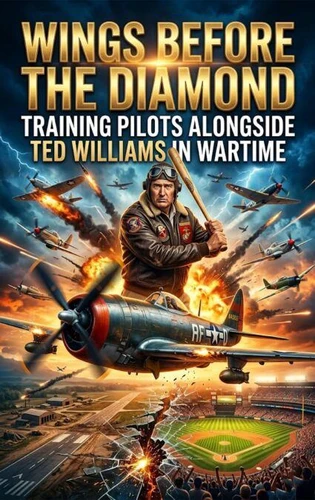
Wings Before the Diamond. Training Pilots Alongside Ted Williams in Wartime
Par :Formats :
Disponible dans votre compte client Decitre ou Furet du Nord dès validation de votre commande. Le format ePub est :
- Compatible avec une lecture sur My Vivlio (smartphone, tablette, ordinateur)
- Compatible avec une lecture sur liseuses Vivlio
- Pour les liseuses autres que Vivlio, vous devez utiliser le logiciel Adobe Digital Edition. Non compatible avec la lecture sur les liseuses Kindle, Remarkable et Sony
 , qui est-ce ?
Notre partenaire de plateforme de lecture numérique où vous retrouverez l'ensemble de vos ebooks gratuitement
Pour en savoir plus sur nos ebooks, consultez notre aide en ligne ici
C'est si simple ! Lisez votre ebook avec l'app Vivlio sur votre tablette, mobile ou ordinateur :

- Nombre de pages217
- FormatePub
- ISBN978-3-565-40695-1
- EAN9783565406951
- Date de parution13/04/2026
- Protection num.pas de protection
- Taille2 Mo
- Infos supplémentairesepub
- ÉditeurEmphaloz Publishing House
Résumé
In the summer of 1942, the man widely regarded as the greatest hitter in baseball history set down his bat and picked up a flight manual. Ted Williams joined the Naval Reserve on 22 May 1942 - in the middle of a season he would close by winning the American League Triple Crown - and within months had entered a training pipeline that would reveal something his Red Sox teammates never suspected: he was just as extraordinary in the air as he was at the plate.
His journey from pre-flight school in Amherst and Athens to the flight decks of NAS Pensacola became one of the most remarkable stories of athlete and airman converging in wartime America. The reflexes, coordination, and visual acuity that made Williams a .406 hitter translated with startling precision into the cockpit. At aerial gunnery training in Jacksonville, he broke every existing record, his 20/10 eyesight giving him an almost inhuman capacity to track targets at speed.
His Red Sox teammate Johnny Pesky, who trained alongside him, observed that Williams solved flight problems in fifteen minutes that took the average cadet an hour - and half those cadets held college degrees. On 2 May 1944, Williams received his gold Naval Aviator wings and his commission as a Second Lieutenant in the United States Marine Corps, and NAS Pensacola promptly refused to let him leave: his command of the gull-winged F4U Corsair was so exceptional that the Navy retained him as a flight instructor, teaching the next generation of combat pilots the machine he had mastered.
His journey from pre-flight school in Amherst and Athens to the flight decks of NAS Pensacola became one of the most remarkable stories of athlete and airman converging in wartime America. The reflexes, coordination, and visual acuity that made Williams a .406 hitter translated with startling precision into the cockpit. At aerial gunnery training in Jacksonville, he broke every existing record, his 20/10 eyesight giving him an almost inhuman capacity to track targets at speed.
His Red Sox teammate Johnny Pesky, who trained alongside him, observed that Williams solved flight problems in fifteen minutes that took the average cadet an hour - and half those cadets held college degrees. On 2 May 1944, Williams received his gold Naval Aviator wings and his commission as a Second Lieutenant in the United States Marine Corps, and NAS Pensacola promptly refused to let him leave: his command of the gull-winged F4U Corsair was so exceptional that the Navy retained him as a flight instructor, teaching the next generation of combat pilots the machine he had mastered.
A propos de Elton Quill





24,99 €



9,99 €