A routine disruptor who overcame chaos in his consulting days, crafting self-help habit systems, business guides for flexible operations, and historical accounts of productivity shifts in wartime economies.
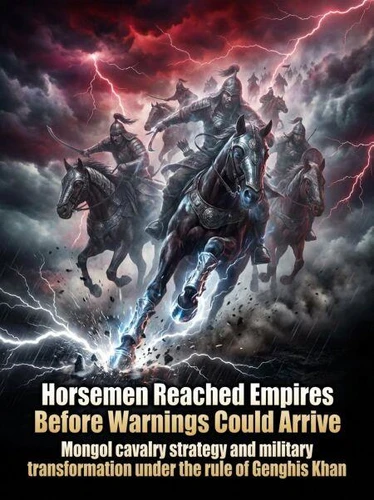
Horsemen Reached Empires Before Warnings Could Arrive. Mongol cavalry strategy and military transformation under the rule of Genghis Khan
Par :Formats :
Disponible dans votre compte client Decitre ou Furet du Nord dès validation de votre commande. Le format ePub est :
- Compatible avec une lecture sur My Vivlio (smartphone, tablette, ordinateur)
- Compatible avec une lecture sur liseuses Vivlio
- Pour les liseuses autres que Vivlio, vous devez utiliser le logiciel Adobe Digital Edition. Non compatible avec la lecture sur les liseuses Kindle, Remarkable et Sony
 , qui est-ce ?
Notre partenaire de plateforme de lecture numérique où vous retrouverez l'ensemble de vos ebooks gratuitement
Pour en savoir plus sur nos ebooks, consultez notre aide en ligne ici
C'est si simple ! Lisez votre ebook avec l'app Vivlio sur votre tablette, mobile ou ordinateur :

- Nombre de pages146
- FormatePub
- ISBN978-3-565-47802-6
- EAN9783565478026
- Date de parution05/06/2026
- Protection num.pas de protection
- Taille967 Ko
- Infos supplémentairesepub
- ÉditeurEmphaloz Publishing House
Résumé
The Mongol conquests reshaped Eurasia through speed, coordination, and military discipline unlike anything neighboring civilizations had previously encountered. Nomadic armies moved across enormous distances with logistical flexibility that overwhelmed slower imperial systems rooted in fortified cities and rigid command structures.
This book examines the military doctrine that enabled Genghis Khan to unify the Mongol tribes and construct the largest contiguous land empire in history.
Merit-based leadership replaced older aristocratic loyalties, while highly mobile cavalry units relied on decentralized coordination, intelligence gathering, and psychological warfare to destabilize opponents before direct confrontation even began. The narrative also explores the strategic use of fear within Mongol expansion. Cities that resisted faced devastating reprisals, encouraging surrender elsewhere and reducing the need for prolonged siege warfare.
Communication, discipline, and operational mobility transformed the Mongol army into an instrument capable of rapid adaptation across deserts, mountains, and agricultural regions alike. The Mongol Empire emerges here not simply as a force of destruction, but as a military revolution that permanently altered warfare across Eurasia.
Merit-based leadership replaced older aristocratic loyalties, while highly mobile cavalry units relied on decentralized coordination, intelligence gathering, and psychological warfare to destabilize opponents before direct confrontation even began. The narrative also explores the strategic use of fear within Mongol expansion. Cities that resisted faced devastating reprisals, encouraging surrender elsewhere and reducing the need for prolonged siege warfare.
Communication, discipline, and operational mobility transformed the Mongol army into an instrument capable of rapid adaptation across deserts, mountains, and agricultural regions alike. The Mongol Empire emerges here not simply as a force of destruction, but as a military revolution that permanently altered warfare across Eurasia.
A propos de Elton Quill






24,99 €


9,99 €