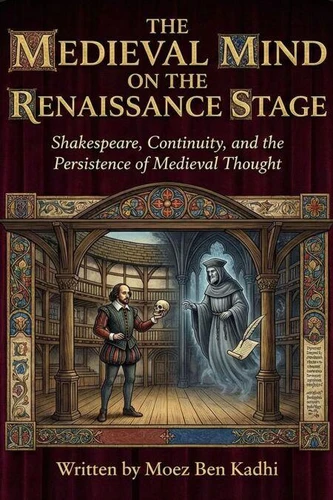
The Medieval Mind on the Renaissance Stage explores the complex persistence of medieval thought in Shakespeare's theatre, challenging the conventional notion that the Renaissance represents a sharp rupture from the Middle Ages. Historically, the Renaissance is often portrayed as a period characterized by humanist optimism, empirical inquiry, and secularized ethical frameworks, in contrast to the medieval emphasis on cosmic order, hierarchical structure, and providential oversight.
This book argues, however, that Shakespeare's works demonstrate a far more intricate temporal and intellectual continuity: medieval cognitive, ethical, and imaginative structures endure, refracted through the theatre of the early modern period, shaping interpretation, moral responsibility, and dramatic consequence in ways that are both intellectually compelling and ethically dangerous. At the core of this study is the thesis that Shakespeare preserves and interrogates medieval frameworks across his oeuvre.
The medieval mind, as represented in these plays, is characterized by a set of interlocking cognitive and ethical structures: hierarchical order, moral intelligibility, the causal weight of hidden forces, the ethical necessity of correct interpretation, and the presence of providence and miracle. These structures persist not as nostalgic remnants or historical curiosities but as operational principles of narrative, character psychology, and dramatic design.
They inform the logic of the plot, the motivations of characters, and the experience of the audience, generating tension, ethical reflection, and, frequently, catastrophe.
The Medieval Mind on the Renaissance Stage explores the complex persistence of medieval thought in Shakespeare's theatre, challenging the conventional notion that the Renaissance represents a sharp rupture from the Middle Ages. Historically, the Renaissance is often portrayed as a period characterized by humanist optimism, empirical inquiry, and secularized ethical frameworks, in contrast to the medieval emphasis on cosmic order, hierarchical structure, and providential oversight.
This book argues, however, that Shakespeare's works demonstrate a far more intricate temporal and intellectual continuity: medieval cognitive, ethical, and imaginative structures endure, refracted through the theatre of the early modern period, shaping interpretation, moral responsibility, and dramatic consequence in ways that are both intellectually compelling and ethically dangerous. At the core of this study is the thesis that Shakespeare preserves and interrogates medieval frameworks across his oeuvre.
The medieval mind, as represented in these plays, is characterized by a set of interlocking cognitive and ethical structures: hierarchical order, moral intelligibility, the causal weight of hidden forces, the ethical necessity of correct interpretation, and the presence of providence and miracle. These structures persist not as nostalgic remnants or historical curiosities but as operational principles of narrative, character psychology, and dramatic design.
They inform the logic of the plot, the motivations of characters, and the experience of the audience, generating tension, ethical reflection, and, frequently, catastrophe.

 , qui est-ce ?