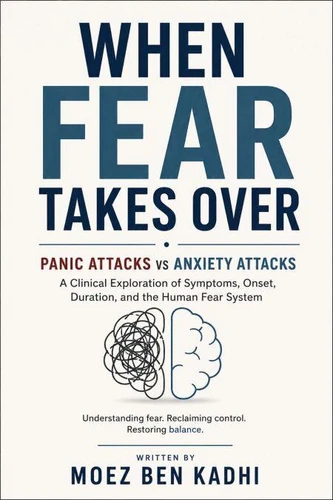
When Fear Takes Over: Panic Attacks vs Anxiety Attacks - A Clinical Distinction in Symptoms, Onset, and Duration is a psychologically grounded, clinically informed exploration of how human fear responses manifest across a spectrum of acute and chronic states. The book examines panic attacks and anxiety attacks not as isolated diagnostic labels, but as interconnected expressions of a shared neurophysiological threat system.
Drawing on contemporary cognitive-behavioral theory, affective neuroscience, and clinical psychology, the work differentiates panic and anxiety through key parameters including onset speed, symptom intensity, duration, and patterns of cognitive interpretation. Panic is conceptualized as a sudden autonomic surge characterized by rapid physiological escalation and perceptual distortion, while anxiety is described as a sustained state of anticipatory activation maintained by cognitive loops, hypervigilance, and threat prediction mechanisms.
In addition to clinical exposition, the book integrates narrative case studies to illustrate how these processes appear in lived experience, including presentations in emergency medical settings, chronic daily anxiety states, and post-panic behavioral adaptation. Special attention is given to misinterpretation patterns in healthcare environments, the development of avoidance behaviors, and the transition from acute episodes to chronic emotional exhaustion.
When Fear Takes Over: Panic Attacks vs Anxiety Attacks - A Clinical Distinction in Symptoms, Onset, and Duration is a psychologically grounded, clinically informed exploration of how human fear responses manifest across a spectrum of acute and chronic states. The book examines panic attacks and anxiety attacks not as isolated diagnostic labels, but as interconnected expressions of a shared neurophysiological threat system.
Drawing on contemporary cognitive-behavioral theory, affective neuroscience, and clinical psychology, the work differentiates panic and anxiety through key parameters including onset speed, symptom intensity, duration, and patterns of cognitive interpretation. Panic is conceptualized as a sudden autonomic surge characterized by rapid physiological escalation and perceptual distortion, while anxiety is described as a sustained state of anticipatory activation maintained by cognitive loops, hypervigilance, and threat prediction mechanisms.
In addition to clinical exposition, the book integrates narrative case studies to illustrate how these processes appear in lived experience, including presentations in emergency medical settings, chronic daily anxiety states, and post-panic behavioral adaptation. Special attention is given to misinterpretation patterns in healthcare environments, the development of avoidance behaviors, and the transition from acute episodes to chronic emotional exhaustion.

 , qui est-ce ?