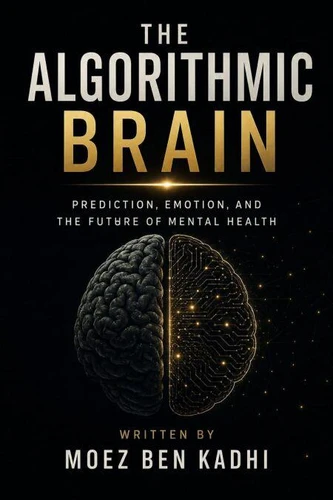
The Algorithmic Brain: Prediction, Emotion, and the Future of Mental Health. This work presents a unified computational framework for understanding human cognition, emotion, and psychopathology through the lens of predictive processing. It proposes that the brain operates as a hierarchical probabilistic system that continuously generates predictions about the world, the body, and the self, updating these models through error-driven learning.
Within this framework, perception is understood as inference, emotion as informational feedback about predictive states, and behavior as the result of adaptive model selection under uncertainty. Mental disorders are reconceptualized as disruptions in predictive dynamics rather than discrete categorical diseases. Anxiety is interpreted as the overestimation of threat probability and excessive precision of negative predictions, depression as a collapse in reward prediction and reduced motivational updating, obsessive-compulsive phenomena as maladaptive uncertainty minimization strategies, and dissociative states as breakdowns in model integration across hierarchical levels.
Trauma is described as a form of frozen prediction in which prior models become rigidly encoded and resistant to updating. The work extends this computational perspective to therapeutic processes, proposing that psychotherapy functions as a structured mechanism for controlled prediction error and model revision. Exposure-based interventions are framed as safe violations of maladaptive predictions, while pharmacological treatments are conceptualized as modulators of precision, gain, and learning thresholds within neural systems.
Neural plasticity is presented as the biological substrate of adaptive updating, enabling cognitive flexibility when appropriately engaged.
The Algorithmic Brain: Prediction, Emotion, and the Future of Mental Health. This work presents a unified computational framework for understanding human cognition, emotion, and psychopathology through the lens of predictive processing. It proposes that the brain operates as a hierarchical probabilistic system that continuously generates predictions about the world, the body, and the self, updating these models through error-driven learning.
Within this framework, perception is understood as inference, emotion as informational feedback about predictive states, and behavior as the result of adaptive model selection under uncertainty. Mental disorders are reconceptualized as disruptions in predictive dynamics rather than discrete categorical diseases. Anxiety is interpreted as the overestimation of threat probability and excessive precision of negative predictions, depression as a collapse in reward prediction and reduced motivational updating, obsessive-compulsive phenomena as maladaptive uncertainty minimization strategies, and dissociative states as breakdowns in model integration across hierarchical levels.
Trauma is described as a form of frozen prediction in which prior models become rigidly encoded and resistant to updating. The work extends this computational perspective to therapeutic processes, proposing that psychotherapy functions as a structured mechanism for controlled prediction error and model revision. Exposure-based interventions are framed as safe violations of maladaptive predictions, while pharmacological treatments are conceptualized as modulators of precision, gain, and learning thresholds within neural systems.
Neural plasticity is presented as the biological substrate of adaptive updating, enabling cognitive flexibility when appropriately engaged.


 , qui est-ce ?