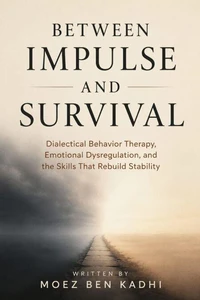
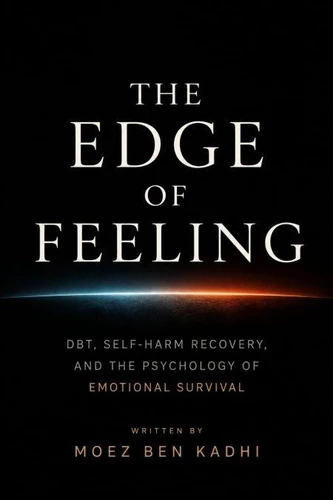
The Edge of Feeling: DBT, Self-Harm Recovery, and the Psychology of Emotional Survival is a clinically grounded, narrative-driven exploration of emotional dysregulation and recovery through the lens of Dialectical Behavior Therapy (DBT), affective neuroscience, and systems-based psychology. The book examines how intense emotional sensitivity, when combined with invalidating environments, physiological vulnerability, and learned reinforcement patterns, can produce cycles of overwhelm, impulsive coping, dissociation, and shame-based identity formation.
Rather than framing self-harm and related behaviors as traits of identity or moral failure, the work conceptualizes them as state-dependent regulatory strategies, emergency attempts by the nervous system to reduce unbearable internal intensity. Across structured chapters, the text maps the progression from emotional escalation and threshold collapse to crisis behaviors, dissociative shutdown, and post-crisis shame cycles.
It then reconstructs these processes through DBT-informed frameworks including mindfulness of current emotion, distress tolerance, emotion regulation, interpersonal effectiveness, and relapse integration. Each module is presented as both psychological model and lived phenomenology, emphasizing how emotional states shape perception, cognition, and behavior under varying levels of physiological load.
A central thesis of the work is that recovery is not the elimination of emotional intensity, but the expansion of regulatory capacity within it. Emotional stability is reframed as a trainable system property emerging from repeated cycles of awareness, interruption, repair, and environmental restructuring. Identity is similarly redefined as a longitudinal pattern shaped by memory integration and state-dependent learning, rather than a fixed outcome of past dysregulation.
The Edge of Feeling: DBT, Self-Harm Recovery, and the Psychology of Emotional Survival is a clinically grounded, narrative-driven exploration of emotional dysregulation and recovery through the lens of Dialectical Behavior Therapy (DBT), affective neuroscience, and systems-based psychology. The book examines how intense emotional sensitivity, when combined with invalidating environments, physiological vulnerability, and learned reinforcement patterns, can produce cycles of overwhelm, impulsive coping, dissociation, and shame-based identity formation.
Rather than framing self-harm and related behaviors as traits of identity or moral failure, the work conceptualizes them as state-dependent regulatory strategies, emergency attempts by the nervous system to reduce unbearable internal intensity. Across structured chapters, the text maps the progression from emotional escalation and threshold collapse to crisis behaviors, dissociative shutdown, and post-crisis shame cycles.
It then reconstructs these processes through DBT-informed frameworks including mindfulness of current emotion, distress tolerance, emotion regulation, interpersonal effectiveness, and relapse integration. Each module is presented as both psychological model and lived phenomenology, emphasizing how emotional states shape perception, cognition, and behavior under varying levels of physiological load.
A central thesis of the work is that recovery is not the elimination of emotional intensity, but the expansion of regulatory capacity within it. Emotional stability is reframed as a trainable system property emerging from repeated cycles of awareness, interruption, repair, and environmental restructuring. Identity is similarly redefined as a longitudinal pattern shaped by memory integration and state-dependent learning, rather than a fixed outcome of past dysregulation.

 , qui est-ce ?