He creates business, history, and self-help books with a sharp, minimal, and internationally marketable tone.
Nouveauté
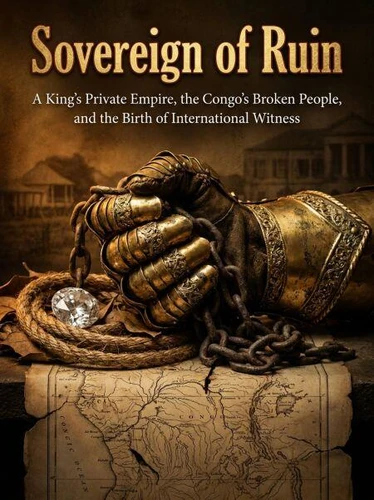
Sovereign of Ruin. A King's Private Empire, the Congo's Broken People, and the Birth of International Witness
Par :Formats :
Disponible dans votre compte client Decitre ou Furet du Nord dès validation de votre commande. Le format ePub est :
- Compatible avec une lecture sur My Vivlio (smartphone, tablette, ordinateur)
- Compatible avec une lecture sur liseuses Vivlio
- Pour les liseuses autres que Vivlio, vous devez utiliser le logiciel Adobe Digital Edition. Non compatible avec la lecture sur les liseuses Kindle, Remarkable et Sony
 , qui est-ce ?
Notre partenaire de plateforme de lecture numérique où vous retrouverez l'ensemble de vos ebooks gratuitement
Pour en savoir plus sur nos ebooks, consultez notre aide en ligne ici
C'est si simple ! Lisez votre ebook avec l'app Vivlio sur votre tablette, mobile ou ordinateur :

- Nombre de pages544
- FormatePub
- ISBN978-3-565-63519-1
- EAN9783565635191
- Date de parution11/08/2026
- Protection num.pas de protection
- Taille1 Mo
- Infos supplémentairesepub
- ÉditeurEmphaloz Publishing House
Résumé
At the height of the Victorian age, a European monarch convinced the world's great powers that he intended to bring civilization to Central Africa. What he built instead was something the diplomatic language of the era had no adequate word for - a privately owned extraction regime operating across a territory seventy-five times the size of Belgium, administered through terror, enforced through mutilation, and concealed behind the calculated rhetoric of humanitarian progress.
The Congo Free State was not a colony in any conventional administrative sense.
It was a personal estate. Leopold II owned it as property, directed its policies as sovereign, and harvested its rubber and ivory as commercial yield. The system he designed rested on a single, brutal mechanism: production quotas enforced by the systematic amputation of hands. The severed limb was not incidental cruelty. It was institutional evidence - proof submitted to station commanders that cartridges had been spent on human targets rather than wasted in the forest.
The consequence was demographic catastrophe. Scholars estimate the Congolese population declined by several million during the Free State period, a collapse measured not only in death but in displacement, starvation, and the deliberate destruction of communities that failed to produce. What ultimately dismantled this system was neither military force nor diplomatic revision. It was testimony - gathered by a shipping clerk named E.
D.
It was a personal estate. Leopold II owned it as property, directed its policies as sovereign, and harvested its rubber and ivory as commercial yield. The system he designed rested on a single, brutal mechanism: production quotas enforced by the systematic amputation of hands. The severed limb was not incidental cruelty. It was institutional evidence - proof submitted to station commanders that cartridges had been spent on human targets rather than wasted in the forest.
The consequence was demographic catastrophe. Scholars estimate the Congolese population declined by several million during the Free State period, a collapse measured not only in death but in displacement, starvation, and the deliberate destruction of communities that failed to produce. What ultimately dismantled this system was neither military force nor diplomatic revision. It was testimony - gathered by a shipping clerk named E.
D.