He creates business, history, and self-help books with a sharp, minimal, and internationally marketable tone.
Nouveauté
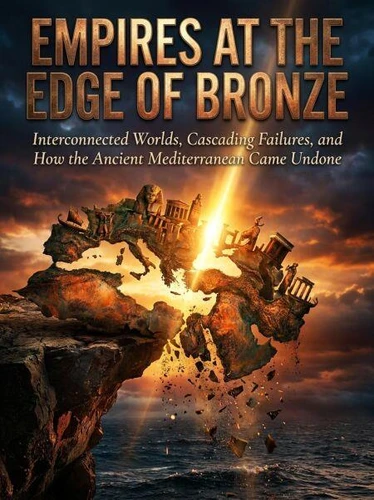
Empires at the Edge of Bronze. Interconnected Worlds, Cascading Failures, and How the Ancient Mediterranean Came Undone
Par :Formats :
Disponible dans votre compte client Decitre ou Furet du Nord dès validation de votre commande. Le format ePub est :
- Compatible avec une lecture sur My Vivlio (smartphone, tablette, ordinateur)
- Compatible avec une lecture sur liseuses Vivlio
- Pour les liseuses autres que Vivlio, vous devez utiliser le logiciel Adobe Digital Edition. Non compatible avec la lecture sur les liseuses Kindle, Remarkable et Sony
 , qui est-ce ?
Notre partenaire de plateforme de lecture numérique où vous retrouverez l'ensemble de vos ebooks gratuitement
Pour en savoir plus sur nos ebooks, consultez notre aide en ligne ici
C'est si simple ! Lisez votre ebook avec l'app Vivlio sur votre tablette, mobile ou ordinateur :

- Nombre de pages545
- FormatePub
- ISBN978-3-565-63461-3
- EAN9783565634613
- Date de parution11/08/2026
- Protection num.pas de protection
- Taille1 Mo
- Infos supplémentairesepub
- ÉditeurEmphaloz Publishing House
Résumé
For nearly three centuries, the Late Bronze Age Mediterranean functioned as something remarkably close to a globalized world - kingdoms trading across open sea lanes, palace economies dependent on copper from Cyprus and tin from distant Anatolia, diplomatic correspondence flowing between pharaohs and Hittite kings in a language neither spoke natively. It was a system of extraordinary reach and, as the twelfth century BCE would make catastrophically clear, extraordinary fragility.
When it ended, it ended almost everywhere at once. Eric Cline's foundational scholarship on 1177 BCE has established that no single cause explains the Bronze Age collapse. What destroyed the Mycenaean palaces, depopulated Ugarit, and fractured Egypt's imperial grip over the Levant was not one blow but the simultaneous convergence of pressures that a complex, tightly coupled system had no capacity to absorb.
The maritime confederacy known as the Sea Peoples delivered visible, documented violence - their movements recorded on temple walls at Medinet Habu with the administrative precision of a power desperate to frame chaos as manageable threat. But the Sea Peoples arrived into a world already under strain. Prolonged drought across the eastern Mediterranean had reduced harvests across multiple growing seasons.
Internal palace redistribution systems - the engines of Bronze Age economic coherence - were failing before the first ship arrived in hostile waters.
When it ended, it ended almost everywhere at once. Eric Cline's foundational scholarship on 1177 BCE has established that no single cause explains the Bronze Age collapse. What destroyed the Mycenaean palaces, depopulated Ugarit, and fractured Egypt's imperial grip over the Levant was not one blow but the simultaneous convergence of pressures that a complex, tightly coupled system had no capacity to absorb.
The maritime confederacy known as the Sea Peoples delivered visible, documented violence - their movements recorded on temple walls at Medinet Habu with the administrative precision of a power desperate to frame chaos as manageable threat. But the Sea Peoples arrived into a world already under strain. Prolonged drought across the eastern Mediterranean had reduced harvests across multiple growing seasons.
Internal palace redistribution systems - the engines of Bronze Age economic coherence - were failing before the first ship arrived in hostile waters.