He creates business, history, and self-help books with a sharp, minimal, and internationally marketable tone.
Nouveauté
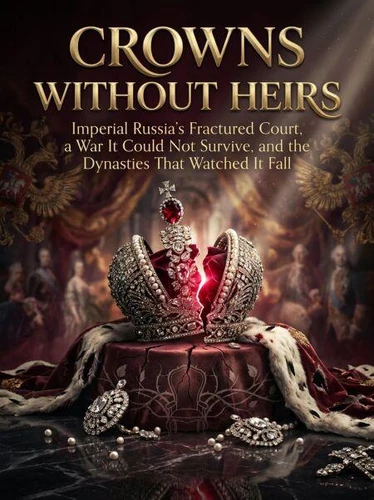
Crowns Without Heirs. Imperial Russia's Fractured Court, a War It Could Not Survive, and the Dynasties That Watched It Fall
Par :Formats :
Disponible dans votre compte client Decitre ou Furet du Nord dès validation de votre commande. Le format ePub est :
- Compatible avec une lecture sur My Vivlio (smartphone, tablette, ordinateur)
- Compatible avec une lecture sur liseuses Vivlio
- Pour les liseuses autres que Vivlio, vous devez utiliser le logiciel Adobe Digital Edition. Non compatible avec la lecture sur les liseuses Kindle, Remarkable et Sony
 , qui est-ce ?
Notre partenaire de plateforme de lecture numérique où vous retrouverez l'ensemble de vos ebooks gratuitement
Pour en savoir plus sur nos ebooks, consultez notre aide en ligne ici
C'est si simple ! Lisez votre ebook avec l'app Vivlio sur votre tablette, mobile ou ordinateur :

- Nombre de pages567
- FormatePub
- ISBN978-3-565-63451-4
- EAN9783565634514
- Date de parution11/08/2026
- Protection num.pas de protection
- Taille1 Mo
- Infos supplémentairesepub
- ÉditeurEmphaloz Publishing House
Résumé
An empire does not collapse in a single moment. It fractures along fissures that were already there - in the architecture of power, in the silence between ministers, in the gap between what a court believes and what a nation endures. By the time Nicholas II stood at the center of a war Russia could not sustain, the administrative machinery of the Romanov state had already been hollowed from within.
The bureaucratic system of the Tsarist court was not simply inefficient. It was structurally incapable of self-correction. Ministers were appointed not for competence but for proximity, loyalty filtered through personal access to the Tsar rather than institutional clarity. At the court's innermost circle, informal influence - embodied most visibly by Rasputin's hold over the imperial family - displaced ministerial authority at the moments when authority was most urgently required.
Economic crisis did not arrive unannounced; it moved through a system that had no mechanism to hear it. The catastrophe of the First World War exposed what the court had long refused to examine. Russia's military logistics were not merely underprepared - they represented a structural mismatch between imperial ambition and industrial capacity. Supply chains collapsed under the weight of campaigns the railway network could not support.
At the front, soldiers who had marched without adequate equipment or coherent command began to encounter something their officers had not anticipated: ideas.
The bureaucratic system of the Tsarist court was not simply inefficient. It was structurally incapable of self-correction. Ministers were appointed not for competence but for proximity, loyalty filtered through personal access to the Tsar rather than institutional clarity. At the court's innermost circle, informal influence - embodied most visibly by Rasputin's hold over the imperial family - displaced ministerial authority at the moments when authority was most urgently required.
Economic crisis did not arrive unannounced; it moved through a system that had no mechanism to hear it. The catastrophe of the First World War exposed what the court had long refused to examine. Russia's military logistics were not merely underprepared - they represented a structural mismatch between imperial ambition and industrial capacity. Supply chains collapsed under the weight of campaigns the railway network could not support.
At the front, soldiers who had marched without adequate equipment or coherent command began to encounter something their officers had not anticipated: ideas.