He creates business, history, and self-help books with a sharp, minimal, and internationally marketable tone.
Nouveauté
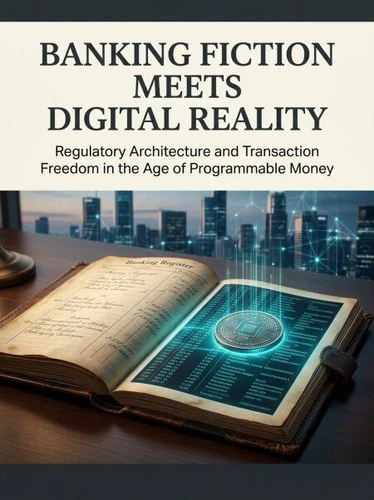
Banking Fiction Meets Digital Reality. Regulatory Architecture and Transaction Freedom in the Age of Programmable Money
Par :Formats :
Disponible dans votre compte client Decitre ou Furet du Nord dès validation de votre commande. Le format ePub est :
- Compatible avec une lecture sur My Vivlio (smartphone, tablette, ordinateur)
- Compatible avec une lecture sur liseuses Vivlio
- Pour les liseuses autres que Vivlio, vous devez utiliser le logiciel Adobe Digital Edition. Non compatible avec la lecture sur les liseuses Kindle, Remarkable et Sony
 , qui est-ce ?
Notre partenaire de plateforme de lecture numérique où vous retrouverez l'ensemble de vos ebooks gratuitement
Pour en savoir plus sur nos ebooks, consultez notre aide en ligne ici
C'est si simple ! Lisez votre ebook avec l'app Vivlio sur votre tablette, mobile ou ordinateur :

- Nombre de pages594
- FormatePub
- ISBN978-3-565-60199-8
- EAN9783565601998
- Date de parution30/07/2026
- Protection num.pas de protection
- Taille1016 Ko
- Infos supplémentairesepub
- ÉditeurEmphaloz Publishing House
Résumé
The transition from analog banking to programmable currency is not a technological upgrade-it is a fundamental restructuring of transactional sovereignty. Digital currencies introduce a layer of conditional logic into money itself, transforming every payment into a potential enforcement mechanism.
This shift redefines the relationship between central banks, commercial intermediaries, and individual autonomy.
When currency can be programmed to expire, restrict usage, or enforce compliance at the protocol level, the nature of economic freedom changes. The architecture of digital money systems determines who controls the conditions under which value can be transferred, stored, or destroyed. Regulatory frameworks are being written now, often without public debate about their long-term implications. The choice is not between innovation and stability, but between transparent governance of programmable money and opaque control embedded in financial infrastructure.
For businesses operating across jurisdictions, understanding these emerging constraints is not optional-it is structural intelligence.
When currency can be programmed to expire, restrict usage, or enforce compliance at the protocol level, the nature of economic freedom changes. The architecture of digital money systems determines who controls the conditions under which value can be transferred, stored, or destroyed. Regulatory frameworks are being written now, often without public debate about their long-term implications. The choice is not between innovation and stability, but between transparent governance of programmable money and opaque control embedded in financial infrastructure.
For businesses operating across jurisdictions, understanding these emerging constraints is not optional-it is structural intelligence.