He creates business, history, and self-help books with a sharp, minimal, and internationally marketable tone.
Nouveauté
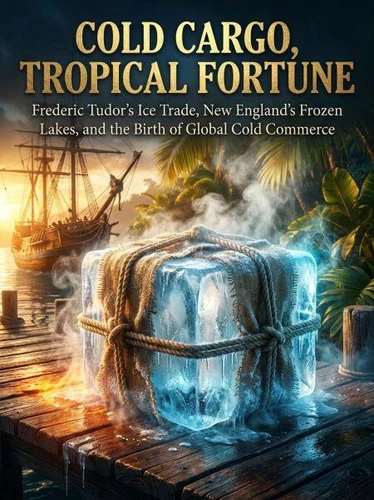
Cold Cargo, Tropical Fortune. Frederic Tudor's Ice Trade, New England's Frozen Lakes, and the Birth of Global Cold Commerce
Par :Formats :
Disponible dans votre compte client Decitre ou Furet du Nord dès validation de votre commande. Le format ePub est :
- Compatible avec une lecture sur My Vivlio (smartphone, tablette, ordinateur)
- Compatible avec une lecture sur liseuses Vivlio
- Pour les liseuses autres que Vivlio, vous devez utiliser le logiciel Adobe Digital Edition. Non compatible avec la lecture sur les liseuses Kindle, Remarkable et Sony
 , qui est-ce ?
Notre partenaire de plateforme de lecture numérique où vous retrouverez l'ensemble de vos ebooks gratuitement
Pour en savoir plus sur nos ebooks, consultez notre aide en ligne ici
C'est si simple ! Lisez votre ebook avec l'app Vivlio sur votre tablette, mobile ou ordinateur :

- Nombre de pages132
- FormatePub
- ISBN978-3-565-63080-6
- EAN9783565630806
- Date de parution10/08/2026
- Protection num.pas de protection
- Taille1 Mo
- Infos supplémentairesepub
- ÉditeurEmphaloz Publishing House
Résumé
Before refrigeration existed, one man from Boston decided to sell winter itself. In 1806, Frederic Tudor loaded ice cut from Massachusetts ponds onto a wooden brig and sailed toward Martinique - arriving to find no icehouse, no buyers prepared, and a near-total loss. What followed was not surrender, but two decades of methodical reinvention. Tudor's commercial ledgers, preserved in meticulous detail, reveal a man who tracked melt rates, insulation experiments, and freight costs with the precision of a modern logistics engineer.
His sawdust-packed holds and double-walled ship compartments were not accidents - they were iterations. By the 1830s, Tudor had cracked the 19th-century supply chain problem that every expert said was unsolvable: shipping 180 tons of frozen water across 16, 000 miles of open ocean to Calcutta without losing the entire cargo to heat. The India trade transformed him into one of the wealthiest men in America, but the deeper story is systemic.
Tudor created demand where none existed, built cold storage infrastructure in tropical ports, and trained local merchants to sell a product that had no cultural precedent. His model - identify an asymmetry, reduce spoilage, educate the market - anticipated the logic of modern commodity trading. The ice trade he founded would outlast him, reaching Hong Kong and São Paulo before mechanical refrigeration rendered it obsolete.
What Tudor built was not merely a business. It was the first proof that perishable goods could move across hemispheres at scale.
His sawdust-packed holds and double-walled ship compartments were not accidents - they were iterations. By the 1830s, Tudor had cracked the 19th-century supply chain problem that every expert said was unsolvable: shipping 180 tons of frozen water across 16, 000 miles of open ocean to Calcutta without losing the entire cargo to heat. The India trade transformed him into one of the wealthiest men in America, but the deeper story is systemic.
Tudor created demand where none existed, built cold storage infrastructure in tropical ports, and trained local merchants to sell a product that had no cultural precedent. His model - identify an asymmetry, reduce spoilage, educate the market - anticipated the logic of modern commodity trading. The ice trade he founded would outlast him, reaching Hong Kong and São Paulo before mechanical refrigeration rendered it obsolete.
What Tudor built was not merely a business. It was the first proof that perishable goods could move across hemispheres at scale.