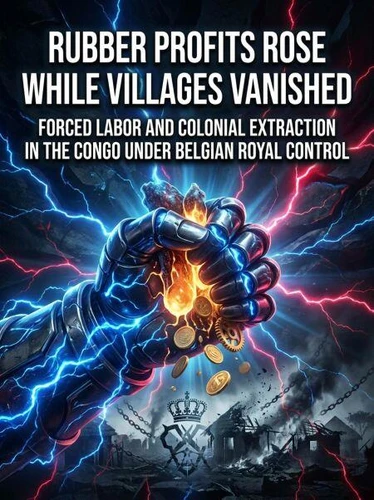
Rubber Profits Rose While Villages Vanished. Forced labor and colonial extraction in the Congo under Belgian royal control
Par :Formats :
Disponible dans votre compte client Decitre ou Furet du Nord dès validation de votre commande. Le format ePub est :
- Compatible avec une lecture sur My Vivlio (smartphone, tablette, ordinateur)
- Compatible avec une lecture sur liseuses Vivlio
- Pour les liseuses autres que Vivlio, vous devez utiliser le logiciel Adobe Digital Edition. Non compatible avec la lecture sur les liseuses Kindle, Remarkable et Sony
 , qui est-ce ?
Notre partenaire de plateforme de lecture numérique où vous retrouverez l'ensemble de vos ebooks gratuitement
Pour en savoir plus sur nos ebooks, consultez notre aide en ligne ici
C'est si simple ! Lisez votre ebook avec l'app Vivlio sur votre tablette, mobile ou ordinateur :

- Nombre de pages162
- FormatePub
- ISBN978-3-565-47790-6
- EAN9783565477906
- Date de parution05/06/2026
- Protection num.pas de protection
- Taille1 Mo
- Infos supplémentairesepub
- ÉditeurEmphaloz Publishing House
Résumé
The Congo became one of the most profitable territories in the colonial world precisely because human life there was treated as expendable. Behind the language of civilization and humanitarian progress stood a system designed to maximize the extraction of rubber and ivory through terror, coercion, and relentless quotas.
This book examines the economic machinery of the Congo Free State under the personal rule of King Leopold II of Belgium.
Armed colonial agents enforced production demands across vast regions where local communities were compelled into labor through hostage-taking, violence, and starvation. Entire villages became tied to global industrial demand for rubber during the rapid expansion of modern manufacturing. The narrative also documents the methods of punishment used to maintain control. Amputations, executions, and collective reprisals formed part of a broader structure intended to enforce obedience through fear.
Population collapse followed as disease, forced displacement, and systematic brutality spread throughout the region. Colonial exploitation appears here not as administrative failure or isolated cruelty, but as an economic system in which violence itself became infrastructure for imperial profit.
Armed colonial agents enforced production demands across vast regions where local communities were compelled into labor through hostage-taking, violence, and starvation. Entire villages became tied to global industrial demand for rubber during the rapid expansion of modern manufacturing. The narrative also documents the methods of punishment used to maintain control. Amputations, executions, and collective reprisals formed part of a broader structure intended to enforce obedience through fear.
Population collapse followed as disease, forced displacement, and systematic brutality spread throughout the region. Colonial exploitation appears here not as administrative failure or isolated cruelty, but as an economic system in which violence itself became infrastructure for imperial profit.