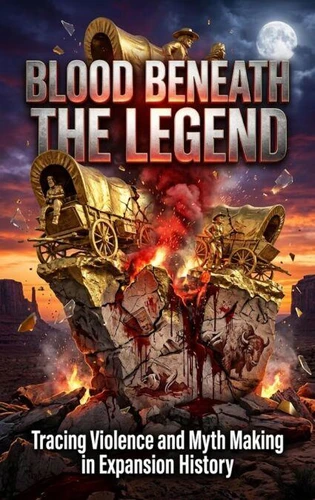
Blood Beneath the Legend. Tracing Violence and Myth Making in Expansion History
Par :Formats :
Disponible dans votre compte client Decitre ou Furet du Nord dès validation de votre commande. Le format ePub est :
- Compatible avec une lecture sur My Vivlio (smartphone, tablette, ordinateur)
- Compatible avec une lecture sur liseuses Vivlio
- Pour les liseuses autres que Vivlio, vous devez utiliser le logiciel Adobe Digital Edition. Non compatible avec la lecture sur les liseuses Kindle, Remarkable et Sony
 , qui est-ce ?
Notre partenaire de plateforme de lecture numérique où vous retrouverez l'ensemble de vos ebooks gratuitement
Pour en savoir plus sur nos ebooks, consultez notre aide en ligne ici
C'est si simple ! Lisez votre ebook avec l'app Vivlio sur votre tablette, mobile ou ordinateur :

- Nombre de pages169
- FormatePub
- ISBN978-3-565-40722-4
- EAN9783565407224
- Date de parution13/04/2026
- Protection num.pas de protection
- Taille2 Mo
- Infos supplémentairesepub
- ÉditeurEmphaloz Publishing House
Résumé
Every nation requires a founding story, and America chose the West. The frontier became the crucible of national identity - a landscape of rugged individualism, heroic lawmen, noble pioneers, and providential destiny stretching toward a Pacific horizon. Dime novels fed it. Paintings glorified it. Buffalo Bill staged it for European royalty in traveling shows that reduced a century of dispossession and bloodshed to choreographed spectacle.
The myth of the American West was not an accident of culture - it was a construction, built with intention, maintained with repetition, and deployed to make palatable what the historical record, examined honestly, cannot easily bear. The violence that accompanied westward expansion was neither incidental nor exceptional. It was policy. The massacres at Sand Creek in 1864 and Wounded Knee in 1890 were not rogue events perpetrated by renegade soldiers - they were the logical extension of federal directives that defined Indigenous resistance as a military problem requiring military solutions.
Vigilante justice on the frontier operated in a legal vacuum that served the interests of land speculators and cattle barons. The gunfighter mythology that celebrated figures like Wyatt Earp and Billy the Kid obscured the economic and racial structures of violence that produced them - men who were less romantic outlaws than symptoms of a frontier society in which the law was selectively applied and lethal force was the primary instrument of order.
The myth of the American West was not an accident of culture - it was a construction, built with intention, maintained with repetition, and deployed to make palatable what the historical record, examined honestly, cannot easily bear. The violence that accompanied westward expansion was neither incidental nor exceptional. It was policy. The massacres at Sand Creek in 1864 and Wounded Knee in 1890 were not rogue events perpetrated by renegade soldiers - they were the logical extension of federal directives that defined Indigenous resistance as a military problem requiring military solutions.
Vigilante justice on the frontier operated in a legal vacuum that served the interests of land speculators and cattle barons. The gunfighter mythology that celebrated figures like Wyatt Earp and Billy the Kid obscured the economic and racial structures of violence that produced them - men who were less romantic outlaws than symptoms of a frontier society in which the law was selectively applied and lethal force was the primary instrument of order.