A two-time career changer who navigated industry crashes, developing self-help confidence builders, business frameworks for transitions, and historical narratives of labor migrations.
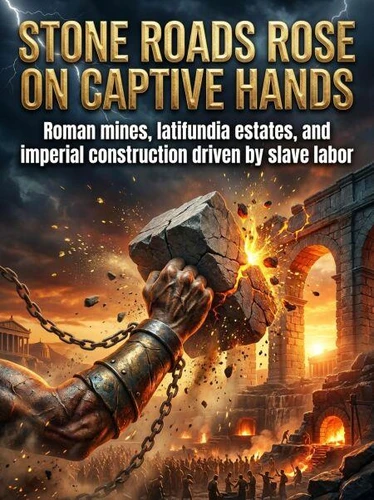
Stone Roads Rose on Captive Hands. Roman mines, latifundia estates, and imperial construction driven by slave labor
Par :Formats :
Disponible dans votre compte client Decitre ou Furet du Nord dès validation de votre commande. Le format ePub est :
- Compatible avec une lecture sur My Vivlio (smartphone, tablette, ordinateur)
- Compatible avec une lecture sur liseuses Vivlio
- Pour les liseuses autres que Vivlio, vous devez utiliser le logiciel Adobe Digital Edition. Non compatible avec la lecture sur les liseuses Kindle, Remarkable et Sony
 , qui est-ce ?
Notre partenaire de plateforme de lecture numérique où vous retrouverez l'ensemble de vos ebooks gratuitement
Pour en savoir plus sur nos ebooks, consultez notre aide en ligne ici
C'est si simple ! Lisez votre ebook avec l'app Vivlio sur votre tablette, mobile ou ordinateur :

- Nombre de pages159
- FormatePub
- ISBN978-3-565-48586-4
- EAN9783565485864
- Date de parution08/06/2026
- Protection num.pas de protection
- Taille1 Mo
- Infos supplémentairesepub
- ÉditeurEmphaloz Publishing House
Résumé
Rome celebrated its roads, aqueducts, and expanding cities as symbols of civilization. Yet beneath every monument stood an economic system dependent on coerced labor drawn from conquest, trade, and inherited bondage. The empire's prosperity rested not only on military power, but on the constant movement of enslaved bodies across its territories.
This book examines slavery as the central engine of the Roman imperial economy.
From silver mines in Hispania to agricultural latifundia in Italy and massive urban construction projects, enslaved labor sustained production at every level of Roman society. Grain exports, metal extraction, and infrastructure expansion all depended on a supply system maintained through warfare and commercial networks spanning the Mediterranean. The narrative also explores Roman legal doctrine surrounding human ownership.
Jurists developed detailed classifications regulating sale, punishment, inheritance, and manumission, creating a structure where certain enslaved individuals could gain limited economic rights while remaining legally subordinate. Freedom itself became a controlled mechanism serving imperial stability rather than humanitarian reform. By tracing labor, law, and coercion together, the book reveals how Roman grandeur emerged through institutions designed to transform conquest into permanent economic dependence.
From silver mines in Hispania to agricultural latifundia in Italy and massive urban construction projects, enslaved labor sustained production at every level of Roman society. Grain exports, metal extraction, and infrastructure expansion all depended on a supply system maintained through warfare and commercial networks spanning the Mediterranean. The narrative also explores Roman legal doctrine surrounding human ownership.
Jurists developed detailed classifications regulating sale, punishment, inheritance, and manumission, creating a structure where certain enslaved individuals could gain limited economic rights while remaining legally subordinate. Freedom itself became a controlled mechanism serving imperial stability rather than humanitarian reform. By tracing labor, law, and coercion together, the book reveals how Roman grandeur emerged through institutions designed to transform conquest into permanent economic dependence.
A propos de Garrett Nolan

9,99 €