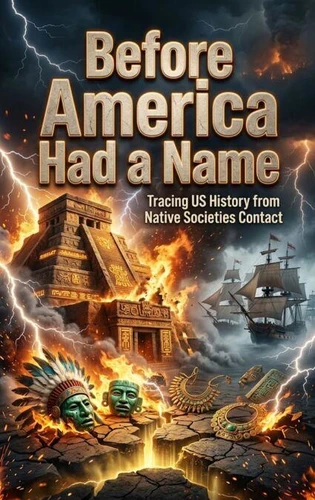
Before America Had a Name. Tracing US History from Native Societies Contact
Par :Formats :
Disponible dans votre compte client Decitre ou Furet du Nord dès validation de votre commande. Le format ePub est :
- Compatible avec une lecture sur My Vivlio (smartphone, tablette, ordinateur)
- Compatible avec une lecture sur liseuses Vivlio
- Pour les liseuses autres que Vivlio, vous devez utiliser le logiciel Adobe Digital Edition. Non compatible avec la lecture sur les liseuses Kindle, Remarkable et Sony
 , qui est-ce ?
Notre partenaire de plateforme de lecture numérique où vous retrouverez l'ensemble de vos ebooks gratuitement
Pour en savoir plus sur nos ebooks, consultez notre aide en ligne ici
C'est si simple ! Lisez votre ebook avec l'app Vivlio sur votre tablette, mobile ou ordinateur :

- Nombre de pages169
- FormatePub
- ISBN978-3-565-40935-8
- EAN9783565409358
- Date de parution14/04/2026
- Protection num.pas de protection
- Taille2 Mo
- Infos supplémentairesepub
- ÉditeurEmphaloz Publishing House
Résumé
The history of the United States does not begin in 1776, nor in 1620, nor even in 1492. It begins approximately 30, 000 years ago, when the first Paleo-Indians followed animal herds across the Beringian land bridge from Siberia into Alaska, and spread southward and eastward over millennia into every ecological zone on the continent. By the time European sails appeared on the Atlantic horizon, the peoples of North America had built cities, cultivated crops, engineered irrigation systems, developed long-distance trade networks spanning thousands of miles, and organized themselves into political confederations of remarkable sophistication.
The standard American origin story, beginning with European arrival, omits the longest and most consequential chapter. Before America Had a Name opens that chapter. It surveys the full sweep of pre-contact and contact-era Native civilization: the Mississippian urban center of Cahokia, which by 1250 CE held a population exceeding 20, 000 and dominated the river corridor from the Great Lakes to the Gulf of Mexico; the Ancestral Puebloans of the Southwest, whose stone-and-adobe cities at Chaco Canyon reflected agricultural mastery of an arid landscape through canal engineering and social organization; the Haudenosaunee Confederacy of the Northeast, whose constitution of collective governance and consensus-based decision-making would, centuries later, find echoes in the minds of framers who had grown up on its borders.
These were not precursors to American civilization. They were civilizations in their own right - complex, adaptive, and profoundly shaped by the environments they had remade over thousands of years.
The standard American origin story, beginning with European arrival, omits the longest and most consequential chapter. Before America Had a Name opens that chapter. It surveys the full sweep of pre-contact and contact-era Native civilization: the Mississippian urban center of Cahokia, which by 1250 CE held a population exceeding 20, 000 and dominated the river corridor from the Great Lakes to the Gulf of Mexico; the Ancestral Puebloans of the Southwest, whose stone-and-adobe cities at Chaco Canyon reflected agricultural mastery of an arid landscape through canal engineering and social organization; the Haudenosaunee Confederacy of the Northeast, whose constitution of collective governance and consensus-based decision-making would, centuries later, find echoes in the minds of framers who had grown up on its borders.
These were not precursors to American civilization. They were civilizations in their own right - complex, adaptive, and profoundly shaped by the environments they had remade over thousands of years.