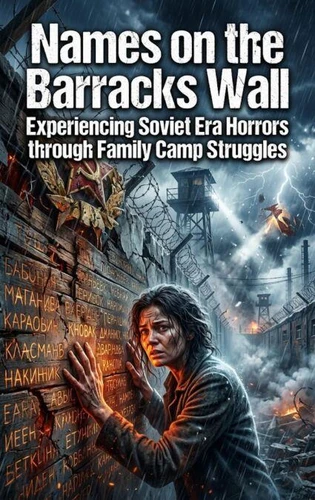
Names on the Barracks Wall. Experiencing Soviet Era Horrors through Family Camp Struggles
Par :Formats :
Disponible dans votre compte client Decitre ou Furet du Nord dès validation de votre commande. Le format ePub est :
- Compatible avec une lecture sur My Vivlio (smartphone, tablette, ordinateur)
- Compatible avec une lecture sur liseuses Vivlio
- Pour les liseuses autres que Vivlio, vous devez utiliser le logiciel Adobe Digital Edition. Non compatible avec la lecture sur les liseuses Kindle, Remarkable et Sony
 , qui est-ce ?
Notre partenaire de plateforme de lecture numérique où vous retrouverez l'ensemble de vos ebooks gratuitement
Pour en savoir plus sur nos ebooks, consultez notre aide en ligne ici
C'est si simple ! Lisez votre ebook avec l'app Vivlio sur votre tablette, mobile ou ordinateur :

- Nombre de pages217
- FormatePub
- ISBN978-3-565-41014-9
- EAN9783565410149
- Date de parution14/04/2026
- Protection num.pas de protection
- Taille2 Mo
- Infos supplémentairesepub
- ÉditeurEmphaloz Publishing House
Résumé
Stalin's terror did not only arrest individuals - it dismembered families. When the NKVD came for a father, the machinery of the Soviet state followed with calculated precision: wives were sentenced to five to eight years in forced labor camps, and children as young as eighteen months were seized and placed in state orphanages, ordered to be monitored for "anti-Soviet sentiments." In less than one year of the Great Terror alone, over 15, 000 children were sent to orphanages when their parents disappeared into the Gulag.
For these families, the horror was not a single event - it was a structured unraveling, engineered step by step by the state. This book enters that unraveling through the intimate record of family experience - the letters sent from the transit trains, the mothers who hid their pregnancies in camp barracks, the children born behind wire who met their fathers only as strangers. It draws on the testimony of survivors like Anton Antonov-Ovseyenko, whose father was executed in the purges, whose mother died by suicide in prison, and who was himself arrested and sent to the Gulag as a young husband - only to return and find his wife had remarried.
These are not exceptional cases. They are the grammar of an era, repeated in millions of variations across the Soviet Union from 1937 onward. Children who survived the camp orphanages carried a particular silence into adulthood - labeled units, the children of "enemies of the people, " they were taught to feel like criminals for the act of loving their parents. Those born inside the camps were taken from their mothers at age two and transferred to state institutions, entering a world in which teachers were forbidden to show them affection for fear of appearing sympathetic to the condemned.
What the Gulag destroyed was not merely freedom - it was the language of family itself, the capacity to belong to someone without that belonging becoming a crime.
For these families, the horror was not a single event - it was a structured unraveling, engineered step by step by the state. This book enters that unraveling through the intimate record of family experience - the letters sent from the transit trains, the mothers who hid their pregnancies in camp barracks, the children born behind wire who met their fathers only as strangers. It draws on the testimony of survivors like Anton Antonov-Ovseyenko, whose father was executed in the purges, whose mother died by suicide in prison, and who was himself arrested and sent to the Gulag as a young husband - only to return and find his wife had remarried.
These are not exceptional cases. They are the grammar of an era, repeated in millions of variations across the Soviet Union from 1937 onward. Children who survived the camp orphanages carried a particular silence into adulthood - labeled units, the children of "enemies of the people, " they were taught to feel like criminals for the act of loving their parents. Those born inside the camps were taken from their mothers at age two and transferred to state institutions, entering a world in which teachers were forbidden to show them affection for fear of appearing sympathetic to the condemned.
What the Gulag destroyed was not merely freedom - it was the language of family itself, the capacity to belong to someone without that belonging becoming a crime.