A two-time career changer who navigated industry crashes, developing self-help confidence builders, business frameworks for transitions, and historical narratives of labor migrations.
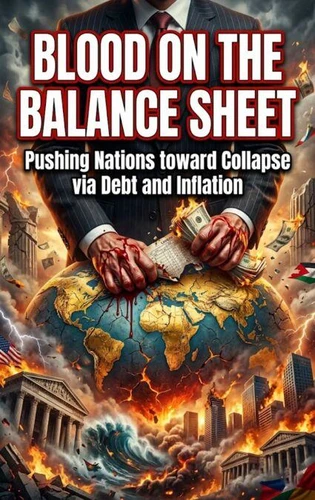
Blood on the Balance Sheet. Pushing Nations toward Collapse via Debt and Inflation
Par :Formats :
Disponible dans votre compte client Decitre ou Furet du Nord dès validation de votre commande. Le format ePub est :
- Compatible avec une lecture sur My Vivlio (smartphone, tablette, ordinateur)
- Compatible avec une lecture sur liseuses Vivlio
- Pour les liseuses autres que Vivlio, vous devez utiliser le logiciel Adobe Digital Edition. Non compatible avec la lecture sur les liseuses Kindle, Remarkable et Sony
 , qui est-ce ?
Notre partenaire de plateforme de lecture numérique où vous retrouverez l'ensemble de vos ebooks gratuitement
Pour en savoir plus sur nos ebooks, consultez notre aide en ligne ici
C'est si simple ! Lisez votre ebook avec l'app Vivlio sur votre tablette, mobile ou ordinateur :

- Nombre de pages191
- FormatePub
- ISBN978-3-565-41091-0
- EAN9783565410910
- Date de parution14/04/2026
- Protection num.pas de protection
- Taille2 Mo
- Infos supplémentairesepub
- ÉditeurEmphaloz Publishing House
Résumé
The path from sovereign debt to national collapse has never been a sudden rupture - it is a slow architecture of miscalculation, denial, and deferred pain, repeated across centuries with remarkable consistency. When a government can no longer borrow to repay its debts, it faces a sequence that history has made grimly familiar: it prints money, devalues its currency, inflates away the real value of what it owes, and watches living standards collapse as the cost is transferred, without consent or transparency, from the state onto the households least able to absorb it.
Inflation, as economists from John Cochrane to Kenneth Rogoff have observed, is not merely an economic phenomenon - it is a form of sovereign default conducted in plain sight, dressed in the language of monetary policy rather than admitted as the political failure it invariably represents. The historical record is unambiguous in its patterns. Weimar Germany between 1921 and 1923 saw hyperinflation so severe that workers were paid twice daily and rushed to spend their wages before the next hour's devaluation erased their value - a collapse driven not by market accident but by a government that had financed the First World War entirely through debt and continued printing money as reparation obligations mounted.
Argentina's recurring debt crises - in 1890, 1982, 1989, 2001, and again in subsequent decades - trace the same structural failure: fiscal deficits financed by external borrowing, debt denominated in foreign currency the state could not print, and the eventual disintegration of public trust in institutions whose credibility had been sacrificed, crisis by crisis, to short-term political survival. Zimbabwe's hyperinflation of 2008 - which reached an estimated 89.7 sextillion percent annually - demonstrated, at the most extreme scale, what occurs when monetary policy is entirely subordinated to political necessity and no institutional constraint remains to resist it.
Inflation, as economists from John Cochrane to Kenneth Rogoff have observed, is not merely an economic phenomenon - it is a form of sovereign default conducted in plain sight, dressed in the language of monetary policy rather than admitted as the political failure it invariably represents. The historical record is unambiguous in its patterns. Weimar Germany between 1921 and 1923 saw hyperinflation so severe that workers were paid twice daily and rushed to spend their wages before the next hour's devaluation erased their value - a collapse driven not by market accident but by a government that had financed the First World War entirely through debt and continued printing money as reparation obligations mounted.
Argentina's recurring debt crises - in 1890, 1982, 1989, 2001, and again in subsequent decades - trace the same structural failure: fiscal deficits financed by external borrowing, debt denominated in foreign currency the state could not print, and the eventual disintegration of public trust in institutions whose credibility had been sacrificed, crisis by crisis, to short-term political survival. Zimbabwe's hyperinflation of 2008 - which reached an estimated 89.7 sextillion percent annually - demonstrated, at the most extreme scale, what occurs when monetary policy is entirely subordinated to political necessity and no institutional constraint remains to resist it.