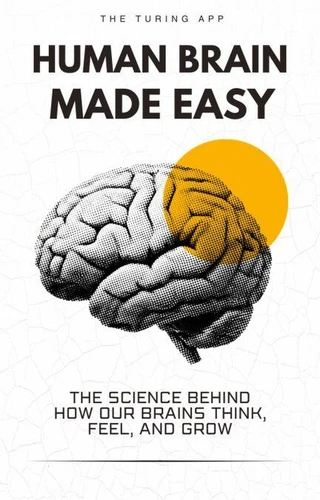
This book is an essential guide to the most mysterious organ in the body: the human brain. Written in everyday language, we tell you the story of neuroscience. At its heart, we answer the question: how does a physical brain create a private inner world? The book begins with the brain's basic sparks: neurons, synapses, neurotransmitters, glial cells, and the vast networks that turn single electrical impulses into thoughts, perceptions, and behavior.
It explores how scientists are beginning to map the brain's parts and wiring, from human cell atlases to connectomes that reveal the hidden architecture of neural circuits. The book also shows that perception is more than a recording of reality. The brain is a prediction machine, constantly guessing what the world is, filtering what matters through attention, and turning intention into action through motor circuits, the basal ganglia, and the cerebellum.
It also explores illusions, phantom limbs, pain, and the fragile construction of the body's internal map. We discuss memory and learning, showing how the hippocampus, synapses, dopamine, plasticity, habit, curiosity, and sleep reshape the brain across a lifetime. We explore emotions as bodily predictions, decisions as a dance between fast intuition and slow reasoning, language as the tool of culture, and consciousness as neuroscience's deepest unresolved mystery.
We ask how damaged brains can heal, from Alzheimer's and depression to stroke, trauma, lifestyle, and the gut-brain axis. It ends at the frontier: brain-computer interfaces, neuromodulation, organoids, AI, brain atlases, and the ethical question of what happens when we can read, write, and perhaps rewrite the circuits of the self.
This book is an essential guide to the most mysterious organ in the body: the human brain. Written in everyday language, we tell you the story of neuroscience. At its heart, we answer the question: how does a physical brain create a private inner world? The book begins with the brain's basic sparks: neurons, synapses, neurotransmitters, glial cells, and the vast networks that turn single electrical impulses into thoughts, perceptions, and behavior.
It explores how scientists are beginning to map the brain's parts and wiring, from human cell atlases to connectomes that reveal the hidden architecture of neural circuits. The book also shows that perception is more than a recording of reality. The brain is a prediction machine, constantly guessing what the world is, filtering what matters through attention, and turning intention into action through motor circuits, the basal ganglia, and the cerebellum.
It also explores illusions, phantom limbs, pain, and the fragile construction of the body's internal map. We discuss memory and learning, showing how the hippocampus, synapses, dopamine, plasticity, habit, curiosity, and sleep reshape the brain across a lifetime. We explore emotions as bodily predictions, decisions as a dance between fast intuition and slow reasoning, language as the tool of culture, and consciousness as neuroscience's deepest unresolved mystery.
We ask how damaged brains can heal, from Alzheimer's and depression to stroke, trauma, lifestyle, and the gut-brain axis. It ends at the frontier: brain-computer interfaces, neuromodulation, organoids, AI, brain atlases, and the ethical question of what happens when we can read, write, and perhaps rewrite the circuits of the self.

 , qui est-ce ?